
Rentfaster Scarborough Rental Guide for Seniors
This guide explains how to evaluate Rentfaster Scarborough rental opportunities with a focus on senior-friendly living, practical budgeting, and relocation readiness. It outlines objective background on rental search behavior, housing types, and decision criteria for older adults seeking stable accommodations in the Scarborough area.
Why a Scarborough rental decision should start with clarity
Choosing Rentfaster Scarborough listings is not only about finding vacancies—it’s about selecting a rental experience that supports day-to-day routines: safe access, predictable costs, and services that reduce friction during move-in and ongoing tenancy. For seniors (and families supporting them), the very important work usually happens before any lease is signed: confirming suitability, verifying affordability, and ensuring the location matches lifestyle needs.
When clarity is missing, the process tends to become reactive. You may tour a unit that looks workable online, sign paperwork that later reveals restrictive terms, or plan a move only to discover the unit has operational barriers (slow maintenance, unclear entry procedures, or unclear caregiver policies). In Scarborough—where the daily rhythm of errands, clinic visits, and social activities is often tightly connected to transportation options—small uncertainties can quickly become major stressors.
Starting with clarity doesn’t mean making the search complicated. It means setting clear priorities early and translating them into practical questions that can be answered before you commit. For older adults, clarity is also a form of respect: it reduces anxiety, helps avoid miscommunication, and supports informed decision-making.
To make this practical, think of your “clarity checklist” as four overlapping elements: the unit (access and usability), the cost (total monthly affordability and move-in requirements), the operations (maintenance and management responsiveness), and the lifestyle fit (neighborhood practicality and support for mobility needs). When you treat these as distinct categories, it becomes easier to compare rentals objectively—without relying purely on photos or first impressions.
What Rentfaster Scarborough generally represents in the local rental search journey
In practical terms, a platform or marketplace approach like Rentfaster Scarborough fits into how many renters research housing today: compare options, shortlist based on suitability, and then validate details directly with property teams. For older adults, this method can be especially useful because the “right fit” is often a combination of:
- Unit readiness (condition, layout, accessibility features)
- Cost predictability (rent range, expected extras, and payment schedules)
- Neighborhood practicality (walkability, transit access, nearby services)
- Operational support (response times, maintenance processes, tenancy rules)
However, there’s an important nuance: online platforms primarily help with discovery and comparison. They don’t guarantee the details that matter most to seniors. The platform may show a listing, but the lived experience depends on how the property manages day-to-day issues—how quickly the heat works when it’s cold, whether the bathroom vent is repaired when it becomes problematic, and whether management follows through when an urgent safety issue appears.
For families coordinating a move, Rentfaster-style discovery is often only the first chapter. The next chapter is verification. That verification can be handled through standardized question lists, documented notes from viewings, and follow-up messages to confirm details that affect safety and affordability.
In many cases, the most effective way to use Rentfaster resources is to treat the listings as “leads” rather than “answers.” The answer—whether the rental is truly suitable—comes from direct confirmation and careful observation.
Decision criteria that matter very for senior-friendly rental living
From an industry perspective, many move-related issues are “preventable surprises.” Below are the screening questions that typically prevent them—especially when the move is time-sensitive or involves family coordination.
It’s helpful to remember that seniors may face changes in mobility, balance, vision, stamina, or cognitive load over time. Even if today’s mobility needs seem manageable, you should consider whether the unit design and service model could still work if needs increase. This is not about expecting worst-case scenarios—it’s about reducing the probability that the next set of challenges will require a costly and emotionally taxing move.
Also consider how the senior will experience the unit during different times of day. Many accessibility problems show up in low light, during winter evenings, or when the person is tired. A unit that feels fine at midday may become difficult after dark if lighting is poor or stairs lack handrails.
1) Accessibility and mobility fit
Look beyond the word “senior-friendly.” Confirm whether the unit supports your real mobility profile:
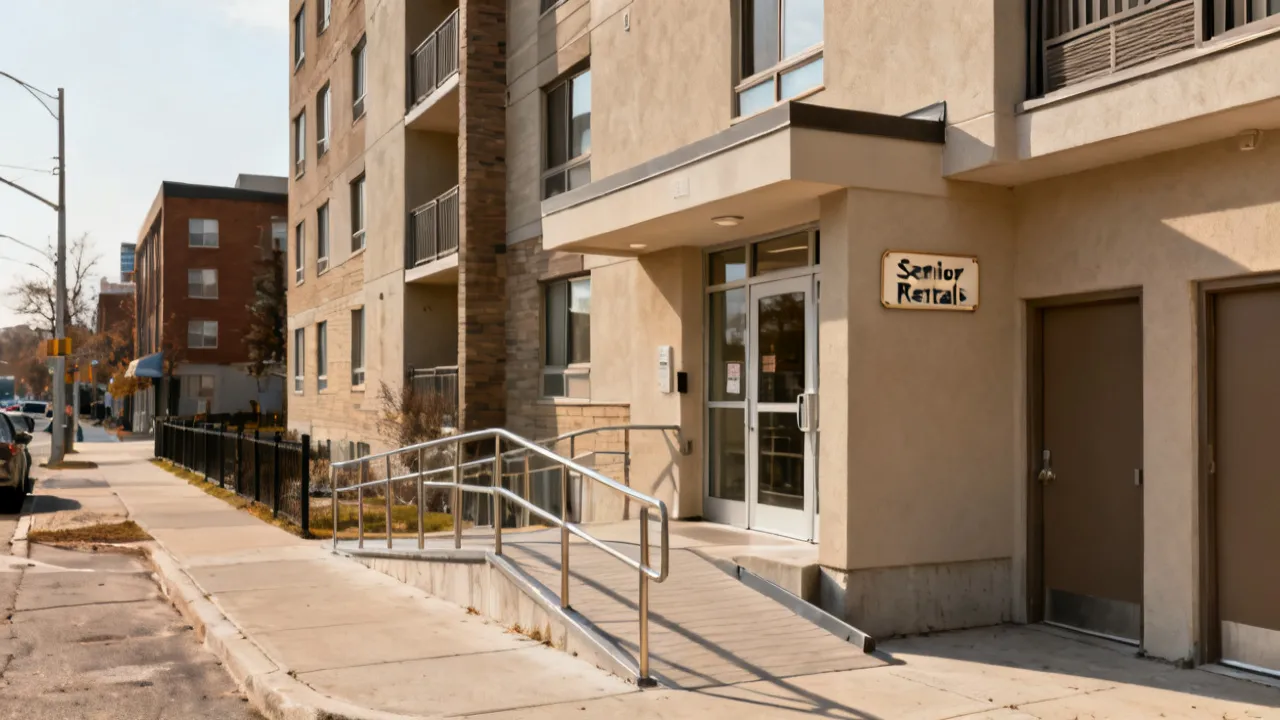
- Step-affordable entry, curb access, and hallway widths
- Bathroom configuration (grab bars readiness, tub vs. walk-in shower)
- Kitchen usability (counter heights, stove accessibility, fridge access)
- Elevator access (if applicable) and proximity to the unit
Expert note: even when buildings have accessibility features, the last 20 meters—from parking/entry to the door—can still be the limiting factor.
To make accessibility evaluation more concrete, you can assess it as a “pathway test.” Seniors don’t usually move in straight lines—they navigate corners, thresholds, doorways, and turns. A unit should be tested for real movement needs such as:
- Turning radius around doorways and furniture placement
- Threshold height at entrances (a subtle lip can cause trips)
- Door hardware (lever handles are often easier than knobs)
- Stair or step transitions (handrails and consistent step heights matter)
- Bathroom clearance around toilet and sink
- Reach range for regularly used items (avoid requiring high shelves)
If the senior uses a walker or wheelchair (or may need it in the future), ask about space for assistive devices. For example, can a walker pass behind a chair at the dining table? Can a wheelchair navigate the doorway widths when turning toward the bathroom?
Another practical consideration: access to emergency help. Some seniors benefit from easily reaching an emergency call device or having a stable place to store a medical alert system. Even if the listing doesn’t explicitly mention it, you can ask how the unit supports safe emergency response—for example, whether hallways have lighting and whether the unit has a consistent phone or internet setup for calling.
Finally, consider bathroom safety design. Grab bars are helpful, but they must be mountable. Some units may have locations that appear suitable but cannot safely support a bar installation because of wall composition or landlord restrictions. Ask whether grab bars are permitted, whether there are policies about drilling, and who is responsible for any repairs after installation.
2) Total monthly affordability—not just base rent
Rentfaster-style comparisons should be refined to “all-in cost awareness.” Base rent might look workable, but recurring extras can change the affordability outcome:
- Parking fees and visitor parking rules
- Utilities included vs. separate billing
- Internet requirements and typical costs
- Move-in costs (deposits, fees, first/last month requirements)
For older renters living on fixed or semi-fixed incomes, predictability frequently matters more than maximizing the lowest headline price.
Affordability is not only about monthly numbers; it’s also about timing and cashflow. A move-in that requires several payments at once can be difficult even if the monthly rent is affordable. Ask early about:
- Whether there are application fees or screening fees
- Whether there’s a last-month rent requirement
- Whether the deposit is refundable and under what conditions
- Whether there are non-refundable admin fees
- What happens if a move date changes
Also consider inflation and seasonal variations. Utilities like heat, cooling, or water usage may fluctuate. If utilities are separate, ask for historical estimates or typical monthly ranges.
For families helping financially, clarity about affordability also reduces interpersonal stress. If the household budget is tight, it’s easier to plan when you know every recurring cost from the beginning rather than discovering later that you need to pay for parking daily or cover new internet equipment.
In practical terms, a good strategy is to build an “all-in monthly cost” worksheet for each candidate unit. Include:
- Base rent
- Parking (monthly or per-visit)
- Internet (if required)
- Hydro/heat/water (if not included)
- Any recurring service charges disclosed in the listing
- Any amenity fees that are not optional
Then compare the worksheet totals—not just the rent price.
3) Maintenance reliability and response pathways
A rental can be structurally fine and still be frustrating if maintenance processes are unclear. Ask how requests are submitted, expected response times, and how urgent issues are handled. For seniors, the key is speed for items that directly impact safety (e.g., bathroom water leaks, heating irregularities, lighting outages).
When maintenance is uncertain, seniors may “delay” reporting issues because it feels like a burden. That delay can worsen problems. A supportive management process makes reporting easier and less stressful.
During inquiry and viewing, request detail on maintenance operations. You can ask:
- What system is used for maintenance requests (email, phone, tenant portal)?
- Is there an after-hours line for emergencies?
- How is “emergency” defined? (e.g., no heat, active water leak, electrical hazards)
- What is the typical response time for urgent vs. non-urgent issues?
- Are tenants given updates when a request is delayed?
- Who is responsible for repairs: the building’s team or third-party contractors?
For older adults, it’s also wise to ask about accessibility during repairs. For instance, if repairs require entry into the unit, how is that scheduled? Is there flexibility for medical appointments? Are there processes for confirming arrival times?
Another factor is the condition of shared spaces. Even if your unit is safe, poorly maintained common areas can impact daily life—e.g., malfunctioning doors, unsafe stairs, inadequate hallway lighting, or broken elevators. If the building has elevators, ask about maintenance history or whether elevator downtime affects entry access for seniors.
Maintenance reliability is not a minor detail: it’s part of the safety system.
4) Community services and practical proximity
Scarborough is diverse and operationally convenient in many pockets, often offering quick access to essentials. Evaluate whether daily needs are reachable without unnecessary stress:
- Pharmacy and grocery access
- Primary care clinics or specialist access nearby
- Transit proximity for appointments
- Quiet environment and noise considerations
When seniors move, it’s usually not only about the unit—it’s about the route to healthcare, food, community, and social connection. A rental may be physically accessible, but if it’s far from necessities, the daily routine becomes harder than expected.
To evaluate practical proximity, consider doing a “one-week map.” Choose the most frequent activities—grocery run, pharmacy pickup, a routine walk or social visit, a clinic appointment—and estimate travel time at different times of day. If the senior uses transit, also consider:
- Whether bus stops or subway access require crossing busy intersections
- Whether sidewalks are well-lit and easy to navigate
- Whether there are steps at transit entrances and whether alternatives exist
- Whether appointment locations require transfers
Noise is also part of daily usability. For seniors, sound can affect sleep quality, concentration, and stress. Ask about building noise levels, but also observe during the viewing—notice traffic noise, floor noise, and whether doors close loudly or corridors echo.
Finally, consider community supports. Nearby accessible community centers, libraries, faith spaces, or senior-friendly programs can reduce isolation and increase support. While these may not be listed in a rental ad, they can strongly affect quality of life.
How to compare listings effectively when using Rentfaster Scarborough resources
A practical evaluation system can reduce decision fatigue. Consider building a shortlist using a simple scoring rubric. An industry-appropriate approach is to treat suitability, cost, and logistics as separate categories rather than mixing them into a single impression.
Decision fatigue is common when there are too many listings or when the criteria are vague. By creating a structured scoring approach, you force clarity. You’re also more likely to notice tradeoffs—for example, a unit may be cheaper but located farther from services, or it may be accessible but has high parking fees.
Step-by-step shortlisting workflow:
- Collect candidate units from Rentfaster Scarborough or comparable local sources.
- Verify core facts (lease length, unit availability date, included amenities).
- Assess mobility fit (entry, bathroom, hallway navigation, elevator access).
- Model monthly affordability (base rent + predictable extras).
- Confirm operational support (maintenance process and response expectations).
- Check neighborhood practicality (daily errands and appointment travel time).
- Validate with a viewing and a short “safety and usability walk-through.”
To expand this into something actionable, you can use a “4-box score” worksheet:
- Unit Usability (0–5): bathroom setup, doorway widths, turning space, lighting, thresholds, kitchen reach.
- Affordability (0–5): all-in monthly cost clarity, fee predictability, cashflow at move-in.
- Operations (0–5): maintenance process clarity, response times, emergency pathways, tenant communication.
- Lifestyle Fit (0–5): access to essentials, transit for appointments, noise comfort, community supports.
Then add a “must-pass” rule: if the unit fails a must-have requirement—like unsafe bathroom access or unclear maintenance pathways—remove it regardless of score. This prevents you from being seduced by aesthetics or a low price that doesn’t match safety needs.
A final comparison method is to create a “questions list” per unit. For each candidate, assign the most important missing info, then ask those exact questions in the viewing or via follow-up. This reduces wasted time because you’re not reinventing questions for each listing.
Comparison of official-style resources for locating lower-cost senior living rentals
Different jurisdictions label housing categories differently (e.g., independent living, assisted living, retirement communities). To focus on lower-cost options while maintaining verifiability, the following table compares the types of information commonly provided by established, publicly accessible organizations.
| Organization type | What it typically helps you compare | Top suited for |
|---|---|---|
| U.S. senior housing resources | Options directory, selection guidance, and planning checklists | Understanding senior living categories and how to choose among them |
| U.S. community directories | Listings, pricing-related information, and care types | Side-by-side comparison across regions |
| Advocacy-focused senior law resources | Rights and guidance relevant to housing and care decisions | Risk reduction through better-informed questions |
| Move-management associations | Certified support for transitions into senior living | Coordinating a move with professional assistance |
source: www.aarp.org
source: www.seniorliving.org
source: www.nsclc.org
source: www.nasmm.org
Note: This section is included to help readers structure their research using established reference sources; specific pricing still needs confirmation per property and market conditions.
Detailed method to find lower-cost senior living options in English-speaking countries
Lower-cost housing options exist, but the search needs structure. Below is a detailed, repeatable workflow that works across English-speaking markets.
Even though your immediate goal may be a Scarborough-area rental (or something like it), the same principles apply to senior living categories: reduce uncertainty, verify fee mechanics, and confirm suitability through direct questioning.
When you compare “lower-cost,” you’re often comparing more than price. You may be comparing fewer included services, a smaller living space, a different care model, or a different community size. That’s not necessarily bad. The risk is choosing a “lower-cost” option without understanding what tradeoffs are being made.
1) Start with category clarity
Before searching, clarify whether you are looking for:
- Independent living (more autonomy, fewer care services)
- Assisted living (help with activities of daily living)
- Memory care (specialized support for cognitive conditions)
- Active adult communities (age-focused lifestyle with predictable engagement)
This is crucial because pricing structures and included services differ significantly by category. For example:
- Independent living may have a lower base price but relies on residents (and sometimes families) for certain supports.
- Assisted living typically includes some personal assistance, but costs may scale with level of care.
- Memory care often has the highest baseline due to staffing and specialized safety operations, though some communities may offer different fee schedules.
- Active adult communities may not resemble “care” settings, but they can be a lower-cost alternative if mobility and support needs are minimal.
Clarity here prevents misalignment. A unit that “sounds” affordable may not be affordable once you add the services that your family actually needs.
2) Use directories for structured comparison
Directory platforms typically allow filtering by region and care type. For lower cost, prioritize:
- Smaller communities outside the very expensive urban cores
- Units with simpler amenity packages
- Options that clearly separate rent from service fees
Directories are helpful for discovering possibilities you may not find through general rental sites. They can also help you compare care types and operational rules. However, directories can sometimes present incomplete information. Always verify the specifics with the provider—especially when affordability is a priority.
A useful technique is to capture the listing details into a spreadsheet (or notes app) so you can compare consistently. Create columns for:
- Category (independent/assisted/memory)
- Monthly cost and what it includes
- Required deposits or move-in fees
- Care level and how care is determined
- Waiting lists or availability dates
- Therapies or services included
- Transportation policies for appointments
This makes it easier to avoid the “I think it was included” problem, which is very common in fast searches.
3) Validate pricing mechanics
Lower cost can sometimes mean different fee structures. Ask for documentation that explains:
- What is included in monthly rent
- What services are extra and how they are billed
- Move-in costs and payment timing
When you ask about pricing mechanics, you are looking for clarity about the difference between “advertised monthly” and “real monthly.” For instance, some communities include meals, housekeeping, and utilities; others charge separately. Likewise, some charge for transportation or medication management.
In addition to monthly cost, consider the rate of change over time. Ask how rent adjustments are made and how often changes occur. This matters for seniors on fixed budgets.
Also ask about “care progression fees.” For example, if someone needs more assistance later, the cost may increase. Understanding that model early helps your family plan financially and emotionally.
4) Reduce the risk of hidden constraints
Consider legal and rights-based guidance when evaluating contracts, tenancy terms, and care/service adjustments. Advocacy-oriented resources can help you generate better questions before signing.
Hidden constraints often show up in contractual language rather than marketing copy. Examples of constraints that can affect your cost and daily life include:
- Restrictions on visitors, especially if family must visit frequently
- Restrictions on caregiver access or support workers
- Policies about medical equipment or mobility devices
- Rules about personal modifications (grab bars, ramps, etc.)
- Automatic fee increases or broad adjustment clauses
- Termination clauses and notice periods
Reducing risk also means verifying how disputes are handled and what escalation paths exist if services are not delivered as promised.
5) Consider professional move-management for efficiency
Transitions can be complex for seniors and families. Move managers can reduce errors and streamline organization—particularly when timing is tight or family members live far away.
Professional move-management can help with:
- Inventorying belongings and planning reduction or downsizing
- Coordinating transportation and scheduling assistance
- Organizing documentation for lease or residency requirements
- Managing communication with property teams
- Creating a move-in readiness checklist so the senior can settle safely
Even if you don’t hire a move manager, the approach is valuable: make a structured plan with roles (who schedules, who confirms, who checks accessibility, who verifies costs). This reduces last-minute confusion.
Rental cost ranges for senior-typical rentals (rental costs only) in selected countries
The following ranges are broad planning estimates for rental cost comparisons by city type. Actual quotes vary by property, unit size, and included amenities, so treat them as budgeting baselines rather than commitments.
| Country | City Type | Price Range |
|---|---|---|
| United States | Large cities | About $2,000–$4,000 per month |
| United States | Smaller cities | About $1,000–$2,000 per month |
| United Kingdom | Large cities | About £1,500–£3,000 per month |
| United Kingdom | Smaller cities | About £800–£1,500 per month |
| Australia | Large cities | About AUD 2,000–AUD 3,500 per month |
| Australia | Smaller cities | About AUD 1,200–AUD 2,000 per month |
| Spain | Large cities | About €800–€1,500 per month |
| Spain | Smaller towns | About €400–€800 per month |
| Peru | Large cities | About PEN 1,500–PEN 3,000 per month (roughly $400–$800) |
| Peru | Smaller towns | About PEN 800–PEN 1,500 per month (roughly $200–$400) |
| Argentina | Large cities | About ARS 30,000–ARS 60,000 per month (roughly $300–$600) |
| Argentina | Smaller towns | About ARS 15,000–ARS 30,000 per month (roughly $150–$300) |
| Mexico | Large cities | About MXN 10,000–MXN 20,000 per month (roughly $500–$1,000) |
| Mexico | Smaller towns | About MXN 5,000–MXN 10,000 per month (roughly $250–$500) |
| France | Paris | About €1,200–€2,500 per month |
| France | Other cities | About €600–€1,200 per month |
| Germany | Large cities | About €1,000–€2,000 per month |
Because this table is intentionally broad, it should be used only for high-level planning. For practical decision-making, you should always request the most recent pricing quote and written breakdown of what is included.
If you are comparing lower-cost options, pay special attention to what is excluded. A cheaper monthly rent may have higher fees for meals, transportation, personal care assistance, or utilities—making it more expensive overall.
Rentfaster Scarborough: practical considerations for a Scarborough-area move
When the search is centered on Rentfaster Scarborough, the decision is often shaped by real-world constraints—timing, mobility limitations, and family involvement. Here are the very common expert-recommended considerations for this type of move.
Scarborough is not a single lifestyle environment; it includes many neighborhoods with different “feel.” The right rental may depend on whether the senior prefers quiet residential streets, proximity to busy commercial corridors, or closeness to transit hubs. A unit’s success is often determined by how well the location supports routine life, not only by its physical features.
Viewing strategy that prevents “layout surprises”
Many rentals look similar online, but layout usability differs. During viewing, evaluate:
- Path from entrance to bedroom (turning radius, obstructions)
- Whether the bathroom door and sink area allow safe maneuvering
- Lighting levels at night and the practicality of switches
- Sound transfer (doors, nearby traffic, building noise)
To prevent surprises, consider performing a “daily-life rehearsal” during the viewing. This means simulating the daily sequence:
- From the entry door to the bathroom (morning route)
- From the entry door to the kitchen (for preparing a drink)
- From the living area to the bedroom (evening route)
- From the unit door to the building exit (even if you won’t go out right away)
This rehearsal helps identify friction points. For instance, you might notice that the bedroom doorway is too narrow for a walker, or that the bedside lamp switch requires standing in a risky position.
Another frequently missed issue is storage and clutter risk. A unit with limited storage can lead to items being placed in hallways or pathways. Hallway clutter is a safety hazard. Ask whether storage closets exist, whether there’s space for mobility aids, and whether there is safe space for medications and medical devices.
Lease terms and tenancy stability
Older renters typically benefit from stability. Verify whether the lease supports continuity and whether renewal terms are predictable. Also confirm policies affecting day-to-day life:
- Visitor rules and short-notice entry
- Caregiver or support-person access (where applicable)
- Rules for mobility devices
- Move-in requirements such as documentation and deposit schedules
Stability is more than the lease term length. It includes the likelihood that the tenant will be required to relocate unexpectedly due to policy changes, major renovations, or building sale. While not all of this is within your control, you can ask targeted questions:
- Are there planned renovations in the building?
- How are rent increases determined year-to-year?
- What is the process for renewing the lease?
- How does the building handle recurring maintenance upgrades (e.g., elevator repairs)?
For families, tenancy stability also affects healthcare logistics. Frequent moves can disrupt medication organization, appointment continuity, and the senior’s sense of control. Therefore, you should evaluate not only whether the lease is stable but also whether the building’s communication style supports stable living.
Communication can be assessed by asking: Do they provide written notices for entry? Is there a tenant portal? Are emergency announcements communicated clearly?
Neighborhood fit: “services within reach”
Scarborough can offer a blend of residential comfort and nearby services. Still, the “within reach” test is personal. A practical approach is to map one week of activities: groceries, pharmacy pickup, routine appointments, and social visits. The goal is to minimize high-effort travel and reduce reliance on last-minute transport.
Beyond the presence of services, consider access barriers. Even if a store is nearby, the route may involve difficult crossings, stairs, or poor sidewalk conditions. For seniors, route difficulty can be as important as the distance.
Another factor is weather-related access. If you live in a cold climate or experience seasonal storms, ask about:
- Snow clearing timelines for sidewalks and entry areas
- Salt or traction management near walkways
- Lighting in common walkways during evening hours
- Whether there are covered entry points to reduce exposure
These issues may not appear in the listing photos but are critical for safe daily movement.
French-speaking country context: structured support and senior community positioning
Although this article primarily addresses a Scarborough rental approach, understanding how other language markets structure senior housing research can inform a better decision-making process. In French-speaking markets, organizations such as Senioriales, Retraite Plus, and FNAQPA illustrate how information, counseling, and quality standards can influence outcomes.
While the specific names and categories differ across countries, the underlying principles—clear guidance, verification of services, and emphasis on rights and quality—are broadly transferable. When families in any region shop for senior housing, they often share the same priorities: safety, support clarity, fairness in fees, and practical daily life.
Positioning comparison (contextual overview)
- Senioriales: focuses on independent senior housing solutions with comfort and safety, typically emphasizing community life and practical services.
- Retraite Plus: acts as a specialized guidance platform to help families find suitable retirement homes or care facilities, with counseling and guidance by needs.
- FNAQPA: works toward improving service quality for older people through policy dialogue, innovation sharing, and better practices.
This contextual overview matters because it highlights the role of “structured support” in improving outcomes. In many markets, families struggle not only to find a place, but to interpret information reliably. When you seek guidance—whether from advocacy groups, directories, or specialized counsel—you increase your ability to ask the right questions and reduce the chance of signing something that doesn’t fit.
You can apply the same structured approach to a Scarborough rental by using a consistent template: define needs, verify pricing mechanics, inspect accessibility, and confirm operational reliability.
Conditions, requirements, and how to use these resources responsibly
When evaluating senior housing or low-cost rental alternatives, it is important to treat online information as a starting point and validate details directly with providers. Below is a structured guide for using official-style resources with a verification mindset.
Responsible use of resources means acknowledging what platforms can do well and what they cannot guarantee. A directory can help you discover and compare. But only the property or provider can confirm current availability, policies, fee details, and operational expectations. Responsible research also means recording details and keeping them consistent, so you don’t mix information across units.
Another responsible step is ensuring the senior’s voice is included. Even if family members handle calls and paperwork, the senior should participate where possible. Ask for their comfort preferences: they may prioritize quietness, proximity to certain routes, ease of walking, or familiarity with neighborhood resources.
| Condition/requirement | Why it matters | How to apply |
|---|---|---|
| Match the care category to the current needs | Wrong category can lead to unexpected costs | Confirm support levels and which services are included vs. billed separately |
| Verify pricing mechanics and fees | Base rent may not reflect total monthly spending | Request the very recent pricing sheet or documented estimate |
| Check operational processes | Maintenance and approvals affect day-to-day life | Ask about maintenance requests, response expectations, and urgency handling |
| Confirm contract/tenancy terms | Lease clauses can influence stability | Review renewal, deposit schedules, and any restrictions |
Expanded screening checklist you can use during calls and viewings
To make the criteria above easier to apply, here is a consolidated screening list that can be used as a script. You can bring this to a phone call, email the management team, or use it during a viewing. The goal is to make sure no crucial details are missed.
- Unit access: “Is the main entrance step-free? What is the route from parking or transit to the unit door?”
- Bathroom usability: “Is there a walk-in shower or a tub? Are grab bars permitted and supported? Is the toilet accessible?”
- Kitchen usability: “Are counters at a comfortable reach? Can the stove be used safely from a seated position?”
- Hallways and doors: “Are doorways wide enough for a walker? How tight are the turns from living area to bedroom?”
- Lighting: “Is there good lighting in hallways and bathrooms? Are switches easy to reach?”
- Maintenance process: “How do I submit a maintenance request? What is the expected timeline for urgent repairs?”
- Emergency support: “Is there an after-hours emergency line? What counts as an emergency?”
- Tenant communication: “Do you provide updates when repairs are delayed? How are tenants notified?”
- Costs: “Can you provide an all-in monthly estimate including utilities and parking, if applicable?”
- Move-in costs: “What are the deposit and any one-time fees? What payment schedule applies?”
- Renewal and stability: “How often do rents increase, and how are renewals handled?”
- Caregiver access and visitors: “What are the visitor rules? Are support persons allowed and what documentation is needed?”
- Safety environment: “How is the building secured? Are common areas well-lit? Is there elevator service reliability?”
When you use a script like this, you reduce reliance on memory. You also help family members coordinate: each person can keep notes, and you can compare answers consistently across units.
FAQs
1) What makes a rental listing “senior-friendly” rather than just “comfortable”?
A senior-friendly rental supports usability and safety in daily routines—step-affordable access where possible, practical bathroom design, manageable layout navigation, predictable maintenance, and a neighborhood that reduces transport strain for appointments and errands.
2) How can I use Rentfaster Scarborough effectively without wasting time?
Shortlist using a clear rubric (accessibility, total affordability, maintenance reliability, and neighborhood practicality). Then validate critical items during a viewing or via direct follow-up questions to the property team.
3) Are lower-cost options usually located only in small towns?
Not always. Some lower-cost opportunities appear in less expensive parts of larger metro areas, in units with fewer amenity extras, or through more flexible pricing structures. The top approach is to compare all-in cost and fee mechanics, not only headline rent.
4) What should families ask about before a senior moves into a rental unit?
Ask about accessibility from parking/entry to the unit, bathroom usability, maintenance response paths, rules for caregivers/support persons (where relevant), visitor policies, and any charges that appear after move-in.
5) How should I interpret cost ranges listed online?
Cost ranges are budgeting estimates and vary by unit type, seasonality, and included services. Use them for planning, then confirm actual pricing directly with the property or management organization.
6) What if the unit isn’t fully accessible—can it still be a good option?
Sometimes, partial accessibility can still work if safety barriers can be addressed. However, you should verify what modifications are allowed (such as grab bar installation or minor safety adjustments) and whether the landlord will permit them. If modifications require drilling or if there are restrictions, the unit may not be suitable. In all cases, you should test your route through the unit and the bathroom specifically.
7) How do I assess maintenance reliability without access to internal records?
Ask for the maintenance request process, typical response times, and emergency handling procedures. If possible, request examples of recent maintenance turnarounds or ask how urgent issues are classified. During a viewing, you can also observe the condition of common areas and the cleanliness around potential maintenance points (lighting fixtures, entryways, elevator areas).
8) What should I do if the senior has frequent medical appointments?
Prioritize neighborhood practicality by mapping appointment travel time and route difficulty. Also ask whether the building or neighborhood supports safe transportation access (well-lit entrances, accessible pickup areas, proximity to transit stops). For families coordinating logistics, plan how the senior will reach appointments if mobility or weather conditions become challenging.
Disclaimer
1) The above information comes from online resources, and the data is as of October 2023. 2) For more information, please refer to the official website.
References (links used in this article)
https://www.aarp.org/caregiving/life-planning/senior-living/
https://www.seniorliving.org/
https://www.nsclc.org/
https://www.nasmm.org/
https://www.senioriales.com/
https://www.retraiteplus.fr/
https://www.fnaqpa.fr/fr