Understanding Acid Corrosion in Engineering
This guide explains 산 부식, commonly translated as acid corrosion, including its chemical mechanisms, environmental triggers, material vulnerabilities, inspection methods, prevention strategies, and repair principles. Acid corrosion occurs when acidic substances react with metallic surfaces, removing protective films and accelerating metal loss. The severity depends on acid type, concentration, temperature, impurities, flow, exposure time, and alloy condition. Sound control requires material selection, process monitoring, protective systems, safe handling, and inspection based on recognized engineering practices.
Introduction: What 산 부식 Means in Engineering
산 부식 is the Korean term commonly used for acid corrosion, the deterioration of a metal or alloy caused by contact with an acidic environment. In practical engineering, the term may describe general metal attack by acids, localized damage such as pitting, corrosion beneath deposits, or failures associated with acidic process fluids. It is not a single corrosion mechanism. Rather, it is a broad description of damage in which acidity contributes materially to the electrochemical or chemical reactions occurring at a surface.
The most important professional conclusion is that acid corrosion should be controlled at the design stage, not discovered only after leakage, loss of strength, or production interruption. A suitable alloy may perform well in one acid service and fail rapidly in another because concentration, temperature, oxidizing conditions, impurities, and fluid movement can change the corrosion mechanism. The same material may therefore show acceptable performance in a dilute solution but suffer severe localized attack in a concentrated, hot, stagnant, or contaminated environment.
Acid corrosion affects storage tanks, heat exchangers, pipelines, valves, pumps, reactors, boilers, exhaust-treatment systems, mining installations, batteries, and laboratory apparatus. It can also occur in apparently ordinary systems when acidic condensation forms on carbon steel, when cleaning chemicals remain on a surface, or when process residues lower the local pH beneath deposits.
For this reason, the phrase 산 부식 should be treated as the beginning of an investigation rather than as a complete diagnosis. A reliable assessment identifies the material, environment, operating conditions, damage morphology, and likely electrochemical reactions before selecting a remedy.
Why Acid Corrosion Requires Careful Analysis
Acidity is often expressed through pH, but pH alone does not predict corrosion performance. pH describes hydrogen-ion activity in a solution, while corrosion behavior also depends on the specific acid, its dissociation characteristics, oxidizing power, concentration, temperature, and interaction with the metal. Chloride ions, dissolved oxygen, sulfur compounds, fluoride ions, and other contaminants may substantially alter the result.
For example, hydrochloric acid is strongly aggressive toward many common steels and can generate hydrogen during metal dissolution. Sulfuric acid may be highly corrosive at some concentrations and temperatures, while certain concentrated conditions can produce passivation in selected alloys. Nitric acid is oxidizing and may support passivation of stainless steel under suitable conditions, but contamination with chlorides or changes in concentration can undermine that protection. Organic acids can also attack metals, particularly when temperature, water content, or impurities increase their reactivity.
Acid corrosion is therefore a system problem. A process engineer must consider not only the bulk liquid but also surfaces where evaporation, condensation, mixing, stagnation, or deposits create a different local environment. A tank may contain a relatively mild solution while its vapor space experiences acidic condensation. A pipeline may be safe under steady flow but develop pits beneath deposits during shutdown. A heat exchanger may suffer attack in a narrow crevice where concentration and oxygen conditions differ from those in the main stream.
The operating history is equally important. Corrosion damage may result from a short excursion that is not visible in routine averages. An incorrect acid dose, temporary loss of dilution water, an upset in temperature control, an extended shutdown, or contamination from another process stream can create conditions that are much more aggressive than the original design basis. Engineering reviews should therefore examine maximum and minimum values, transients, cleaning operations, and abnormal events rather than considering only normal steady-state data.
The Electrochemical Basis of Acid Corrosion
Most corrosion of metals in aqueous acidic environments is electrochemical. The metal surface develops areas where oxidation occurs and areas where reduction occurs. At an anodic site, metal atoms lose electrons and enter the solution as ions. For iron, a simplified anodic reaction is:
Fe → Fe2+ + 2e−
The electrons move through the metal to a cathodic site. In an acidic, oxygen-poor environment, hydrogen-ion reduction may dominate:
2H+ + 2e− → H2
When dissolved oxygen is present, oxygen reduction may also contribute:
O2 + 4H+ + 4e− → 2H2O
The overall corrosion rate depends on the balance between these anodic and cathodic reactions, the conductivity of the electrolyte, the condition of protective films, and transport of reactants and products. Lower pH often increases the availability of hydrogen ions, but the relationship between pH and corrosion rate is not universally linear. A metal can corrode rapidly in an acidic solution even when the measured pH is not extremely low if other factors promote depassivation or localized attack.
Some alloys form passive oxide films that greatly reduce the rate of uniform dissolution. Stainless steels, aluminum alloys, titanium alloys, and nickel-based materials may rely on such films. Acidic environments can dissolve, weaken, or destabilize these films. If the film reforms quickly, the alloy may remain serviceable. If it cannot reform because of low oxygen, aggressive ions, high temperature, abrasion, or chemical contamination, corrosion can accelerate.
Acid corrosion may also be influenced by polarization and mass transfer. A fast-moving fluid can deliver reactants to the surface more rapidly, while a stagnant region can allow corrosion products or aggressive ions to accumulate. In some cases, flow reduces corrosion by preventing deposits; in others, high velocity strips protective films and increases attack. This is why a simple statement that “flow is good” or “flow is bad” is not technically sufficient without considering the specific system.
Primary Forms of Damage
Uniform corrosion
Uniform corrosion removes material relatively evenly across a surface. It is often easier to detect and evaluate than localized corrosion because thickness measurements can provide a useful estimate of remaining wall. Carbon steel exposed to a sufficiently acidic solution may show general thinning, discoloration, roughness, and the formation of corrosion products.
Uniform attack can still be dangerous. A vessel may appear intact while its wall has gradually fallen below the minimum thickness required for pressure, structural, or process service. The correct assessment requires comparison with design thickness, corrosion allowance, inspection history, and applicable construction or integrity standards.
Uniform corrosion is sometimes described as predictable, but this description should be used carefully. Rates may change as acid concentration changes, as the surface becomes rougher, as corrosion products accumulate, or as operating temperatures vary. A single short-term rate should not automatically be used as a long-term forecast.
Pitting corrosion
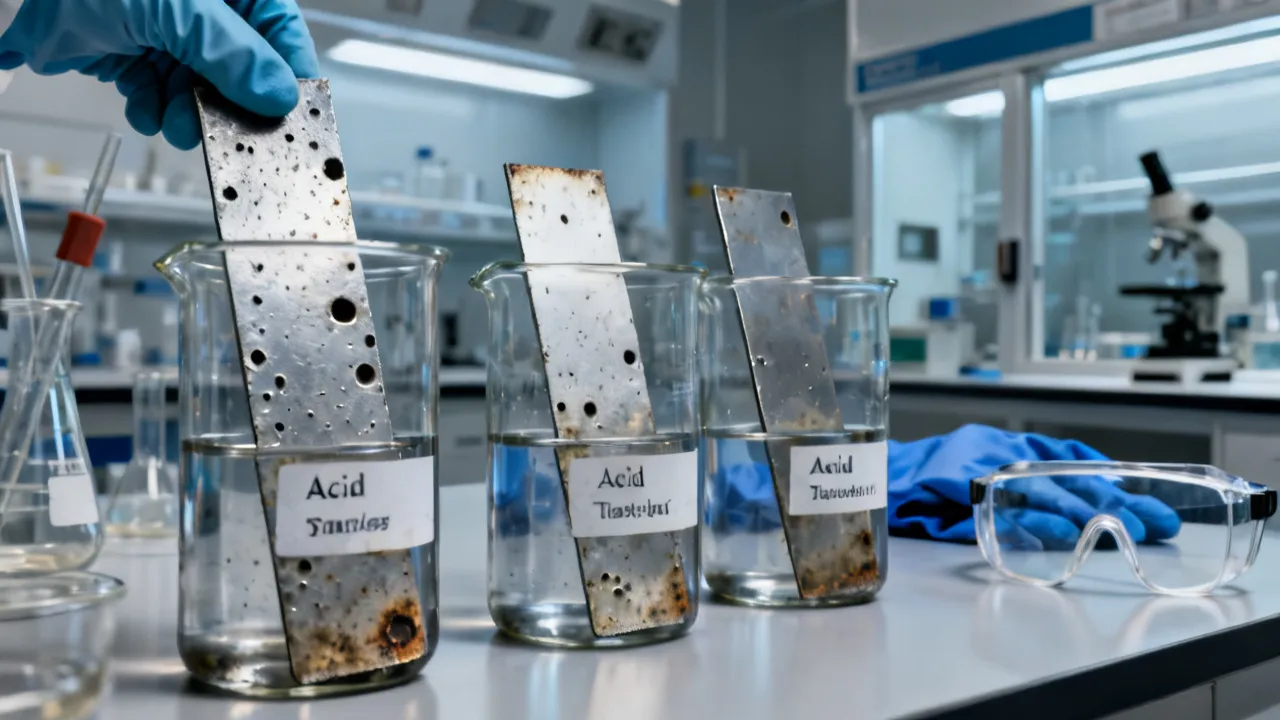
Pitting is a localized form of corrosion that produces small cavities with potentially substantial depth. Acidic conditions can initiate pits directly or make it easier for chloride ions and other aggressive species to break down passive films. Because pits may be narrow at the opening and deep beneath the surface, visual inspection alone can underestimate their severity.
Pitting is especially important in stainless steels and other passive alloys. The presence of acid does not automatically mean that a passive alloy will fail, but acid combined with chlorides, heat, stagnant liquid, or deposits can create a high-risk environment. Pit depth, density, geometry, and growth history should be documented during inspection.
Deep pits can act as stress concentrators and may eventually become leak paths even when the average wall thickness remains adequate. For pressure equipment, the maximum pit depth and remaining ligament between adjacent pits may be more important than an average thickness value.
Crevice corrosion
Crevice corrosion develops in shielded gaps such as gasket interfaces, lap joints, threaded connections, under deposits, and beneath clamps. Within a crevice, oxygen depletion and chemical concentration changes can create a small electrochemical cell. Acidification inside the crevice may become more severe than in the surrounding solution.
Designs that minimize narrow gaps, use appropriate gasket materials, provide drainage, and allow inspection generally reduce the risk. Tightening a joint does not necessarily eliminate the problem if the design continues to trap liquid or process residue.
Crevice geometry is important. A narrow opening may admit electrolyte but restrict the exchange of oxygen and corrosion products. As the local chemistry changes, the crevice may become increasingly aggressive. This mechanism is common around bolted flanges, tube supports, lap-welded seams, and areas beneath scale or sediment.
Galvanic corrosion
Galvanic corrosion occurs when dissimilar conductive materials are electrically connected in an electrolyte. The less noble material becomes more anodic and may corrode faster. An acidic solution often has enough conductivity to support this interaction. The risk depends on the material pairing, surface-area ratio, electrical connection, and chemistry of the electrolyte.
Particular caution is needed when a small carbon-steel component is connected to a large area of a more noble alloy. Electrical isolation, compatible material selection, protective coatings, and suitable joint design can reduce galvanic attack.
Coating strategy is important in galvanic assemblies. If only the anodic material is coated and the coating is damaged, the exposed area may experience concentrated attack. In some designs, it is preferable to coat the more noble component or use a complete electrical isolation system, subject to engineering review.
Erosion-corrosion
High velocity, turbulence, suspended solids, gas bubbles, or sudden changes in flow direction can remove protective films and expose fresh metal. When this mechanical action combines with an acidic electrolyte, corrosion may proceed faster than under static conditions. Typical locations include elbows, pump outlets, control valves, reducers, and impingement zones.
Reducing unnecessary turbulence, selecting suitable flow velocities, controlling solids, improving piping geometry, and choosing a material with adequate resistance can help. A corrosion-resistant alloy may still perform poorly if the process creates severe erosion or cavitation.
Inspection should focus on characteristic locations such as the outer radius of elbows, downstream sides of restrictions, pump discharge areas, and regions where two-phase flow changes direction. Surface grooves, horseshoe-shaped patterns, thinning at weld toes, and polished or unusually smooth attack may indicate an erosion component.
Hydrogen-related damage
Acid corrosion may generate atomic or molecular hydrogen at the metal surface. Some hydrogen can enter the metal rather than immediately forming gas. In susceptible high-strength steels and certain other materials, absorbed hydrogen may contribute to embrittlement, cracking, blistering, or loss of ductility. The risk depends on material strength, microstructure, stress level, welding condition, acid chemistry, inhibitors, and exposure time.
Hydrogen-related damage should not be assumed from surface appearance alone. Fractographic examination, hardness testing, metallurgical analysis, welding-record review, and process history may be necessary. Repairs involving high-strength components require particularly cautious engineering review.
Hydrogen can also collect at internal inclusions, laminations, voids, or interfaces and produce blisters. A component may show surface bulges or delaminated regions even when the original corrosion occurred on the external or internal surface. If hydrogen damage is suspected, ordinary leak repair may be inadequate because the material itself may have lost toughness.
Stress corrosion cracking
Stress corrosion cracking requires the combination of a susceptible material, a specific environment, and tensile stress. Acidic solutions can participate in cracking mechanisms in some alloys, while chloride-bearing acidic environments are particularly important for certain stainless steels. Cracks may be fine, branched, and difficult to see without appropriate non-destructive examination.
Residual stress from welding, cold forming, machining, assembly, or thermal gradients may be sufficient to contribute. A component that has not experienced an obvious overload can still crack if the material-environment-stress combination is unfavorable.
Cracking risk is often increased at welds, bends, threaded areas, attachment points, and locations with sharp geometry. Corrective measures may include reducing tensile stress, changing the alloy, removing contaminants, modifying temperature, or eliminating the aggressive environment. Grinding away visible surface marks without identifying the crack mechanism may leave dangerous defects in place.
Materials Commonly Affected by Acid Corrosion
Carbon steel
Carbon steel is widely used because of its strength, availability, fabricability, and relatively low acquisition cost. Its resistance to many acidic services, however, is limited. It may experience general thinning, pitting, hydrogen evolution, or localized attack depending on the acid and process conditions.
Carbon steel is not automatically unsuitable for every acidic application. It can be used in some controlled services when concentration, temperature, flow, inhibitor performance, and inspection are well defined. The decision should be based on documented compatibility data and a conservative operating envelope rather than on a material label alone.
Welded carbon-steel equipment may have different local behavior from the parent plate because of residual stress, heat-affected zones, weld reinforcement, and surface condition. Low points and areas beneath insulation or deposits may corrode more quickly than exposed surfaces. Corrosion allowance should therefore be supported by targeted inspection.
Stainless steel
Stainless steels depend on chromium-rich passive films for corrosion resistance. They can perform well in many environments, but passivity is not permanent or universal. Low-pH solutions, chlorides, crevices, deposits, high temperature, and welding-related microstructural changes may produce localized attack.
Different stainless grades have different resistance profiles. Austenitic, ferritic, duplex, and precipitation-hardening grades should not be treated as interchangeable. Welds, heat-affected zones, surface contamination, and fabrication practices can influence performance. Cleaning residues containing chlorides or acidic chemicals should be removed according to an approved procedure.
Stainless steel surfaces should be protected from carbon-steel contamination during fabrication, since embedded iron particles may rust and create misleading or damaging surface conditions. Pickling and passivation, where required, should be performed using qualified procedures that are compatible with the equipment and subsequent process service.
Aluminum alloys
Aluminum forms a protective oxide layer in many environments, but strong acids and strong bases can dissolve or destabilize that layer. Acidic solutions may cause general attack, pitting, or rapid surface degradation, particularly when the alloy is exposed to elevated temperature or contaminants.
Aluminum may also be vulnerable to galvanic attack when connected to more noble metals in an acidic, conductive electrolyte. Joint design, insulation, sealants, fastener selection, and drainage are important. Because aluminum has high thermal conductivity, temperature gradients and condensation may create local environments that differ from the bulk process fluid.
Copper and copper alloys
Copper alloys may resist certain non-oxidizing environments but can be vulnerable to oxidizing acids, ammonia-containing conditions, sulfide contamination, or high-velocity fluids. Dezincification and other selective corrosion mechanisms may affect some brass alloys. The alloy composition and exact process chemistry are important.
Deposits containing sulfur compounds or acidic moisture can change the surface chemistry of copper components. In heat exchangers, water quality, oxygen content, velocity, and suspended solids should be considered together. A copper alloy that performs well in clean water may not be suitable for contaminated acidic service.
Nickel-based alloys and titanium
Nickel-based alloys and titanium are often selected for demanding chemical environments, but they are not universally resistant. Specific acids, concentration ranges, oxidizing conditions, fluoride contamination, crevices, and elevated temperatures can limit their use. Their higher material cost makes accurate service definition especially important before procurement.
Titanium generally depends on a stable oxide film and may be highly resistant in many oxidizing environments. However, reducing acids, fluoride-containing solutions, hot concentrated acids, and confined geometries can create exceptions. Nickel alloys also differ significantly from one another; their resistance to one acid does not establish resistance to all mixed-acid services.
Coatings, linings, and non-metallic materials
Glass-lined equipment, fluoropolymers, rubber linings, thermoplastics, ceramics, and other non-metallic systems may provide valuable resistance to selected acids. Their limitations can include temperature sensitivity, permeability, mechanical damage, thermal shock, seam defects, swelling, and attachment difficulties.
A lining should be treated as an engineered barrier rather than an absolute solution. Pinholes, holidays, cracks, poorly prepared substrates, and damaged edges can expose the underlying metal. Inspection and repair procedures should address both the barrier and the substrate.
Factors That Accelerate Acid Corrosion
- Acid identity: Hydrochloric, sulfuric, nitric, phosphoric, hydrofluoric, organic, and mixed acids interact differently with metals.
- Concentration: Corrosion may increase, decrease, or change mechanism as concentration changes.
- Temperature: Higher temperature commonly accelerates reaction kinetics, although specific passivation or concentration effects may modify the trend.
- Water content: Some acids are most aggressive when water enables ion transport, while other concentrated conditions create different behavior.
- Impurities: Chlorides, fluorides, sulfides, oxidants, and metal ions can alter film stability and reaction rates.
- Flow: Velocity and turbulence may remove films and increase mass transfer.
- Stagnation: Poor drainage and deposits can create highly acidic local cells.
- Pressure and stress: Mechanical stress can increase the consequences of localized attack or contribute to cracking.
- Surface condition: Roughness, scale, weld tint, contamination, and scratches may become initiation sites.
- Exposure duration: Short exposure may conceal damage that becomes significant during repeated cycles or long shutdowns.
- Acid mixing: Inadequate mixing can expose surfaces to concentrated acid before dilution occurs.
- Thermal cycling: Repeated heating and cooling can damage coatings, alter condensation patterns, and increase stress at joints.
How Professionals Diagnose 산 부식
A credible diagnosis begins with evidence. The investigator should collect process records, material certificates, fabrication documents, operating temperatures, concentration histories, cleaning procedures, upset events, shutdown records, and previous inspection results. The question is not merely “What acid was present?” but “What chemical and physical environment existed at the damaged location over time?”
Visual examination
Visual examination can reveal discoloration, roughness, deposits, blisters, pits, coating failure, leakage paths, and weld-associated damage. Photographs should include scale references and location identifiers. Surface appearance is useful for mapping damage but rarely sufficient for determining remaining integrity.
Deposits should be described rather than removed immediately without documentation. Their color, thickness, adhesion, moisture, and location may provide clues about the mechanism. A deposit can conceal deep pitting, and aggressive cleaning can accidentally remove evidence or damage a weak lining.
Thickness measurement
Ultrasonic thickness testing is widely used to identify wall loss and establish a thickness profile. Measurements should be taken on a documented grid, with additional readings near welds, low points, drains, nozzles, supports, deposits, insulation interfaces, and visible damage. Instrument calibration, surface condition, probe selection, and operator competence influence result quality.
Where pitting is suspected, a broad grid may need to be supplemented by high-density scanning or a pit-depth gauge. The inspector should understand measurement uncertainty, surface roughness effects, and the possibility that a narrow pit is not fully detected by a conventional probe.
Surface crack examination
Dye penetrant testing can identify surface-breaking discontinuities on suitable non-porous materials. Magnetic particle testing can detect surface and near-surface discontinuities in ferromagnetic materials. These methods are valuable when cracking is suspected, but each has material and surface limitations.
Acid residues must be removed or controlled in accordance with safety procedures before examination. Some chemicals interfere with penetrant materials, damage equipment, or create exposure hazards. Examination planning should involve both inspection and safety personnel.
Radiographic and advanced examinations
Radiographic testing, computed tomography in specialized applications, phased-array ultrasonic testing, and time-of-flight diffraction may assist in evaluating welds, internal defects, or crack-like indications. The appropriate method depends on geometry, access, material, defect orientation, and required sensitivity.
Advanced methods are not automatically superior in every application. Their usefulness depends on qualified procedures, appropriate calibration blocks, experienced interpretation, and a clear understanding of the defect being sought. A method that detects planar cracks well may not be ideal for broad, irregular metal loss.
Chemical and metallurgical analysis
Laboratory analysis of process liquid, deposits, corrosion products, and failed components can clarify the mechanism. Useful analyses may include pH, conductivity, ion composition, dissolved metals, oxidant levels, deposit chemistry, hardness, microscopy, and fracture examination. Samples should be collected and preserved under a documented chain of custody where failure investigation or regulatory review is possible.
Material verification may be necessary when records are incomplete or substitution is suspected. Positive material identification, chemical analysis, hardness testing, and metallographic examination can reveal whether the installed alloy matches the design specification. This is particularly important after maintenance, replacement, or field modification.
Electrochemical testing
Polarization methods, linear polarization resistance, electrochemical impedance spectroscopy, and laboratory immersion tests can provide comparative information. These methods must be designed around the actual material and environment. A laboratory result is not automatically a direct prediction of plant performance, particularly when fluid flow, deposits, welds, or cyclic operation are important.
Testing should reproduce the relevant concentration range, temperature, aeration, flow condition, and surface preparation as closely as practical. If the field problem involves a deposit or crevice, a polished laboratory coupon in a clean solution may not represent the actual mechanism.
Risk-Based Inspection and Remaining Life
Inspection planning should prioritize consequences as well as probability. A small line carrying a hazardous acid may deserve more attention than a larger vessel containing a low-consequence process fluid. A professional assessment considers leak consequences, personnel exposure, environmental impact, production interruption, pressure, temperature, accessibility, and the detectability of damage.
For general thinning, a simplified corrosion rate may be estimated from reliable thickness readings:
Corrosion rate = thickness loss ÷ exposure time
This calculation is meaningful only when the readings are comparable, the measurement uncertainty is understood, and the operating conditions have been reasonably consistent. Future projections should include uncertainty and should not rely on a single measurement. Localized pits require a different approach because the deepest pit, pit growth behavior, and measurement accuracy may govern integrity.
Remaining-life decisions should follow the applicable design code, inspection standard, company engineering practice, and regulatory requirements. Examples of recognized frameworks include standards and recommended practices issued by organizations such as ASTM International, AMPP, ASME, ISO, and relevant national authorities. The exact document depends on equipment type, jurisdiction, material, and service.
Inspection intervals should reflect the expected damage rate and the time required to detect, evaluate, and correct a developing problem. A rapidly changing process may require online monitoring or frequent sampling, while a stable system with extensive historical data may support longer intervals. However, a longer interval should be justified by evidence, not by convenience or the absence of previous failures.
Prevention Through Design
Define the service environment
Before selecting materials, document the acid name, concentration range, minimum and maximum temperatures, pressure, flow velocity, water content, contaminants, cleaning chemicals, startup and shutdown conditions, and expected service life. Include abnormal conditions such as loss of cooling, dosing errors, air ingress, dilution, or process contamination.
Select materials using verified data
Material compatibility should be established through manufacturer data, recognized corrosion handbooks, relevant standards, service history, and testing where necessary. Generic statements such as “stainless steel resists acid” are inadequate because grade, weld condition, acid chemistry, and temperature strongly influence performance.
Lifecycle cost should be considered instead of purchase price alone. A more expensive alloy may reduce maintenance, unplanned shutdowns, product contamination, and replacement labor. Conversely, a costly alloy may be unnecessary if a lower-cost material can be reliably protected through lining, process control, and inspection.
Use corrosion allowance appropriately
A corrosion allowance provides additional thickness for anticipated metal loss. It does not protect against every mechanism and should not substitute for sound material selection. Localized corrosion, cracking, erosion, and unexpected chemistry may defeat an allowance based only on uniform thinning.
Improve geometry and drainage
Equipment should avoid unnecessary crevices, sharp dead legs, stagnant pockets, and inaccessible surfaces. Drainage should prevent acidic liquid from remaining after cleaning or shutdown. Connections, gaskets, supports, and insulation details should be reviewed because these locations often create local environments different from the main process stream.
Low points should have suitable drains or flushing arrangements where practical. Dead legs should be minimized, and branch connections should be designed so that process fluid does not remain trapped during normal operation or shutdown. Inspection access should be considered at the same time as corrosion control; a hidden surface cannot be managed effectively if it cannot be examined.
Control weld quality and surface condition
Weld procedures, filler metals, heat input, post-weld cleaning, passivation where applicable, and inspection should match the material and service. Heat tint, embedded iron, grinding contamination, and rough weld profiles can reduce resistance in some stainless systems. Surface preparation should be controlled rather than improvised in the field.
Design for maintainability
Components exposed to acid should be replaceable, drainable, and accessible for inspection where possible. Removable spool sections, replaceable liners, strategically located inspection ports, and isolation valves can reduce the time and hazard associated with maintenance. Equipment layout should provide sufficient space for safe examination and repair.
Operational Controls
Process control is a major defense against 산 부식. Operators should monitor variables that define the corrosion environment, including pH where meaningful, acid concentration, temperature, flow, conductivity, oxidant level, and contaminant concentration. Alarm limits should be based on engineering analysis and should distinguish normal variation from conditions that require immediate action.
Acid addition systems should prevent concentrated acid from contacting vulnerable surfaces before adequate dilution or mixing. Injection points require suitable materials, proper location, and sufficient mixing distance. Backflow prevention can stop acid from entering systems that were not designed for it.
Shutdown and cleaning procedures deserve particular attention. Equipment should be drained, rinsed, neutralized when appropriate, and dried according to a controlled procedure. Neutralization itself can generate heat, gas, precipitates, or localized concentration changes, so it should not be treated as a casual step.
Inhibitors may reduce corrosion in selected services by altering anodic or cathodic reactions or by forming an adsorbed surface film. Their performance depends on dosage, temperature, acid identity, flow, contaminants, and mixing. An inhibitor should be qualified through testing and monitored in operation. It should not be assumed effective simply because it has worked in another system.
Sampling systems should be designed so that samples represent the process without exposing personnel unnecessarily. Sampling from a stagnant branch or a cold surface may provide a misleading result. Instruments should be calibrated, protected from fouling, and supported by manual verification where the consequence of an incorrect reading is high.
Coatings and Linings
Protective coatings can separate the metal from the acid. The coating system must be compatible with the chemical, temperature, substrate, immersion conditions, mechanical loads, and expected maintenance practice. Surface preparation is often as important as the coating chemistry. Poorly prepared steel may develop disbonding, underfilm corrosion, blistering, or pinholes.
Inspection may include dry-film thickness measurement, holiday detection, adhesion testing, visual examination, and periodic condition assessment. Any repair should address the cause of failure, not merely cover the visible defect. For example, recurring blistering may result from permeation, trapped moisture, osmotic effects, or unsuitable coating selection.
Linings can fail at edges, nozzles, flanges, seams, corners, and areas exposed to impact. The design should specify minimum bend radii, substrate preparation, curing conditions, repair materials, and allowable operating temperatures. Thermal expansion differences between lining and substrate should be evaluated, especially in equipment that experiences rapid heating or cooling.
Cathodic Protection and Its Limitations
Cathodic protection can reduce corrosion of suitable metallic structures by shifting the potential so that the protected surface becomes predominantly cathodic. It is commonly applied in water-containing systems, buried structures, tanks, and marine environments. Its suitability in strongly acidic process equipment must be assessed carefully.
Excessive cathodic protection can produce hydrogen and may damage coatings or increase hydrogen-related risks in susceptible materials. Electrical continuity, anode placement, shielding, reference electrodes, and monitoring must be engineered for the actual system. Cathodic protection is not a universal remedy for acid corrosion.
Stray-current effects should also be considered where electrically connected equipment, grounding systems, welding equipment, or nearby protected structures may alter current distribution. The system should be commissioned using measured potentials and maintained through periodic verification rather than assumed to remain effective indefinitely.
Repair and Replacement Decisions
When acid corrosion is discovered, the first priority is safe containment and hazard control. The equipment may need isolation, depressurization, drainage, rinsing, ventilation, and chemical verification before inspection or repair. Personnel should follow the site’s chemical safety procedures, including suitable protective equipment and emergency arrangements.
Repair options may include controlled weld repair, insert plates, replacement spools, nozzle replacement, lining renewal, coating repair, clamp installation for temporary containment, or complete component replacement. The selected method depends on remaining thickness, damage morphology, material, weldability, process hazard, accessibility, and regulatory approval.
Temporary repairs should have a defined engineering basis, time limit, inspection plan, and replacement strategy. A clamp or patch may control a leak temporarily but does not eliminate the underlying corrosion mechanism. Permanent repairs should restore both structural capacity and chemical compatibility.
Weld repairs require special care when hydrogen damage, cracking, or contaminated surfaces are involved. The repair area may need to be enlarged beyond the visible defect, and preheating, consumable control, heat treatment, and post-repair examination may be required. Welding directly over active corrosion products, residual acid, or a compromised lining can create additional defects.
After repair, verification may include non-destructive examination, pressure or leak testing where appropriate, coating inspection, dimensional checks, material verification, and review of operating limits. The inspection record should document the original damage, cause assessment, repair details, acceptance criteria, and follow-up date.
Health, Safety, and Environmental Considerations
Acid corrosion creates more than an equipment-integrity concern. Leaks can expose workers to corrosive liquids, vapors, aerosols, or reaction products. A failed component may also release pressure, generate hydrogen, contaminate soil or water, or create a secondary reaction with incompatible substances.
Safety planning should identify the acid’s hazard classification, exposure routes, incompatibilities, emergency shower and eyewash access, ventilation requirements, spill-control materials, respiratory protection needs, and waste-handling procedures. Safety data sheets are important references, but site-specific risk assessments and local legal requirements also apply.
Corrosion products and neutralization residues may require controlled collection and disposal. The environmental classification of waste depends on the substance, concentration, contaminants, and jurisdiction. Disposal decisions should be made through the responsible environmental and safety functions rather than by assumption.
Before opening equipment, workers should confirm that it has been isolated from all sources of acid, pressure, heat, and electrical energy. Residual liquid may remain in low points, jackets, instrument connections, or dead legs even after apparent drainage. Gas testing and chemical verification may be necessary before entry or hot work.
Comparison Table: Main Control Strategies
| Strategy | Primary Purpose | Strengths | Important Limitations |
|---|---|---|---|
| Material selection | Prevent attack through chemical compatibility | Can provide durable protection when service conditions are well defined | Performance may change with temperature, impurities, welds, and concentration |
| Corrosion allowance | Provide additional wall thickness for anticipated thinning | Simple and useful for predictable general corrosion | Does not reliably address pitting, cracking, erosion, or unexpected chemistry |
| Coatings and linings | Separate the metal from the acid | Can protect economical substrates and simplify material choices | Pinholes, adhesion failure, permeability, and mechanical damage require control |
| Process monitoring | Keep acidity and related variables within qualified limits | Reduces excursions and supports early intervention | Requires reliable instruments, alarms, sampling, and operator response |
| Inhibitor treatment | Reduce electrochemical reaction rates | May be practical in controlled liquid systems | Effectiveness is chemistry-specific and can decline with poor dosing or contamination |
| Inspection and monitoring | Detect metal loss or cracking before failure | Supports risk-based maintenance and remaining-life decisions | Inspection may miss hidden, inaccessible, or rapidly developing damage |
| Drainage and geometry improvements | Prevent stagnant acidic pockets and crevice conditions | Addresses local environments at the design source | May require equipment modification and process shutdown |
Step-by-Step Guide to Investigating Acid Corrosion
- Make the area safe. Isolate the equipment, control pressure, manage exposure risks, and verify that the chemical condition is understood before opening or testing.
- Define the damaged component. Record equipment identification, material, geometry, weld locations, operating duty, and the exact position of the indication.
- Reconstruct the environment. Review acid type, concentration, temperature, flow, contaminants, cleaning chemicals, startup conditions, shutdown history, and excursions.
- Map visible damage. Photograph and measure discoloration, pits, deposits, cracks, coating failure, leakage, and affected areas.
- Perform suitable non-destructive examination. Select thickness, surface, weld, or advanced examination methods based on the suspected mechanism and access conditions.
- Collect representative samples. Where permitted, analyze liquid, deposits, corrosion products, and removed material using controlled sampling procedures.
- Compare findings with design requirements. Determine minimum thickness, allowable damage, pressure or structural requirements, and applicable inspection criteria.
- Identify the dominant mechanism. Distinguish general thinning from pitting, crevice corrosion, erosion-corrosion, hydrogen damage, galvanic attack, or cracking.
- Choose containment and repair. Select a temporary or permanent action that addresses both integrity and chemical compatibility.
- Prevent recurrence. Modify material, geometry, process control, cleaning, coating, inhibitor management, or inspection frequency as justified by the evidence.
- Document the decision. Preserve measurements, assumptions, test results, approvals, repair records, and follow-up requirements.
Conditions and Requirements for a Reliable Assessment
- The acid identity and concentration range should be known or conservatively estimated.
- Temperature, pressure, flow, and operating cycles should be recorded rather than inferred from normal conditions alone.
- The base material, weld metal, heat treatment, and fabrication history should be verified where possible.
- Inspection equipment should be calibrated, suitable for the surface, and operated by qualified personnel.
- Localized damage should be measured with methods capable of identifying maximum depth and crack-like features.
- Any inhibitor, coating, lining, or cathodic-protection system should have documented design criteria and monitoring records.
- Repairs should be reviewed for chemical compatibility, weldability, structural capacity, and regulatory acceptance.
- Workers should have access to appropriate chemical safety procedures and emergency controls.
- Uncertainty should be included in remaining-life calculations and operating decisions.
- Changes in process chemistry should trigger a management-of-change review.
- Inspection findings should be compared with earlier data so that the rate and pattern of damage can be distinguished from a single isolated reading.
- Similar equipment exposed to the same chemical should be examined for an extent-of-condition assessment.
Common Mistakes in Managing 산 부식
Relying only on pH
pH is useful but incomplete. Two solutions with similar pH values may produce different corrosion behavior because their acid species, buffering capacity, oxidizing conditions, and impurities differ. Chemical composition and operating conditions must be considered together.
Assuming stainless steel is immune
Stainless steel resists corrosion through passivation; it is not immune to every acid. Chlorides, crevices, heat, deposits, weld contamination, and reducing conditions can produce localized damage. Grade selection should follow service-specific evidence.
Using a coating without controlling the substrate
A coating cannot compensate for severe surface contamination, sharp edges, active corrosion, poor drainage, or incompatible service chemistry. Surface preparation, application quality, curing, inspection, and maintenance are all necessary.
Measuring only easy-to-reach areas
Acid corrosion often concentrates at low points, nozzles, supports, welds, deposits, insulation interfaces, and vapor-liquid transitions. A convenient inspection route may miss the most vulnerable locations. Examination plans should be based on damage mechanisms and process geometry.
Ignoring shutdown conditions
Corrosion may accelerate during shutdown because liquid drains into low points, residues concentrate through evaporation, oxygen enters the system, or cleaning chemicals remain in contact with the metal. Normal operating data do not fully represent these periods.
Treating a leak as the entire problem
A visible leak is often the final sign of a broader integrity issue. The surrounding equipment, connected piping, supports, insulation interfaces, and similar components may share the same exposure. Repairs should be accompanied by an extent-of-condition review.
Changing chemicals without a compatibility review
Substituting a cleaning agent, inhibitor, neutralizer, solvent, or raw material can change the corrosion environment even when the primary process acid remains the same. Procurement and maintenance changes should therefore be reviewed for material compatibility.
Industry Sources and Technical Reference Frameworks
Professional decisions about acid corrosion should draw on recognized technical sources rather than generalized internet claims. ASTM International publishes standardized methods for corrosion testing, materials evaluation, and laboratory practice. AMPP develops corrosion-control standards, recommended practices, and professional guidance. ASME codes address the design, construction, inspection, and repair of many pressure-containing systems. ISO standards provide international frameworks for corrosion management, material testing, and quality systems in relevant applications.
National occupational-safety and environmental authorities provide requirements for chemical handling, exposure control, emergency planning, and waste management. Equipment manufacturers and material producers may also provide compatibility charts, but these should be interpreted within the stated test conditions and limitations.
When statistics or corrosion-rate data are needed, the preferred sources are controlled plant records, qualified laboratory testing, peer-reviewed studies, recognized standards, and established engineering handbooks. A corrosion rate from one facility should not be transferred directly to another facility without confirming similarity in material, chemistry, temperature, flow, and inspection method.
Documentation is part of technical quality. A material recommendation should identify the exact grade, product form, welding condition, acid composition, temperature range, assumptions, and limitations. This information allows future engineers to determine whether a process change remains within the original basis of design.
How an Expert Interprets Corrosion Evidence
An experienced corrosion engineer does not select a remedy from appearance alone. Brown rust may indicate general iron corrosion, but it can also cover deep pitting. A smooth-looking surface may conceal subsurface cracking. A failed coating may be the result of chemical permeation, poor adhesion, substrate contamination, or an unsuitable application temperature.
The expert also distinguishes cause from condition. “Low pH” may describe a condition, but the cause could be acid dosing error, contaminated feedstock, microbial activity, condensation, cleaning residue, or an ineffective neutralization step. Corrective action should target the cause that can be controlled.
Another important principle is proportionality. Not every acidic environment requires an exotic alloy, and not every low-cost material can be protected by adding a larger corrosion allowance. The technically sound choice balances hazard, reliability, inspection access, lifecycle cost, maintainability, and consequences of failure.
Good investigations also distinguish between initiating factors and accelerating factors. A scratch or weld defect may initiate localized attack, while chloride contamination, high temperature, or stagnant fluid accelerates it. Identifying both categories leads to stronger corrective action than simply naming the most obvious chemical present.
Frequently Asked Questions
What is 산 부식?
산 부식 means acid corrosion. It describes the deterioration of metals or alloys caused or accelerated by acidic environments. The actual mechanism may be uniform dissolution, pitting, crevice corrosion, erosion-corrosion, galvanic attack, hydrogen-related damage, or stress corrosion cracking.
Does a lower pH always mean faster corrosion?
No. Lower pH often increases the availability of hydrogen ions, but corrosion also depends on acid identity, concentration, temperature, dissolved oxygen, impurities, flow, passive-film behavior, and material condition. pH should be evaluated together with the full chemical and operating profile.
Is stainless steel suitable for acid service?
Some stainless grades are suitable for selected acid services, while others may pit, crack, or corrode generally. The decision depends on acid chemistry, concentration, temperature, chlorides, aeration, crevices, welding, and surface condition. A grade name alone is not enough to confirm compatibility.
Can a corrosion inhibitor stop acid corrosion completely?
Inhibitors generally reduce corrosion under qualified conditions; they do not guarantee complete protection. Their performance can depend on concentration, mixing, temperature, fluid velocity, contamination, and exposure time. Monitoring and periodic verification are necessary.
What inspection method is best for acid corrosion?
There is no single best method for every case. Ultrasonic thickness testing is useful for wall loss, while visual examination, penetrant testing, magnetic particle testing, radiography, advanced ultrasonics, laboratory analysis, and electrochemical testing may be appropriate for other mechanisms. The suspected damage and component geometry should determine the method.
Can acid corrosion occur in a vapor space?
Yes. Acidic vapors can condense on cooler surfaces and produce localized corrosion, particularly near roofs, vents, flanges, insulation interfaces, and liquid-level transitions. Vapor-space inspection should be included when the process can generate acidic fumes or condensate.
Why can corrosion be worse during shutdown?
Shutdowns may create stagnant liquid, concentration through evaporation, oxygen ingress, residual cleaning chemicals, temperature changes, or poorly drained low points. These conditions can differ substantially from normal operation and should be addressed in shutdown procedures.
Is corrosion allowance enough protection?
Corrosion allowance is useful for predictable general thinning, but it may not protect against deep pits, cracking, erosion, crevice corrosion, or unexpected chemistry. It should be combined with appropriate material selection, process control, protective systems, and inspection.
How should a corroded pressure component be repaired?
The component should first be made safe and assessed by qualified personnel. Repair may involve replacement, welding, insert plates, lining renewal, or an engineered temporary containment method. The decision must consider remaining thickness, damage mechanism, material, weldability, pressure, hazard, and applicable codes.
What is the most effective way to prevent 산 부식?
The strongest approach is layered protection: define the chemical service accurately, select compatible materials, eliminate stagnant zones, control process conditions, apply qualified coatings or inhibitors where appropriate, inspect vulnerable locations, and review changes through formal management-of-change procedures.
Conclusion
산 부식 is best understood as a family of acid-related corrosion problems rather than a single failure mode. Its severity is governed by the interaction of chemistry, material, temperature, flow, stress, geometry, surface condition, and time. Effective management begins with accurate service definition and continues through material selection, design, operation, inspection, repair, and documented prevention.
The most reliable engineering practice combines several defenses instead of depending on one measure. A corrosion allowance cannot replace chemical compatibility. A stainless alloy cannot replace process control. A coating cannot replace surface preparation. An inspection program cannot compensate for an uncontrolled acid excursion. When these elements are integrated, organizations can reduce unexpected leakage, protect personnel, maintain equipment integrity, and make repair or replacement decisions on a defensible technical basis.
In practical terms, the correct response to suspected 산 부식 is neither automatic replacement with the most expensive alloy nor reliance on a single pH reading. The correct response is a structured engineering process: make the equipment safe, establish the actual exposure, identify the damage mechanism, measure the remaining integrity, select controls appropriate to the mechanism, and verify that the corrective action remains effective over the equipment’s service life.