A Practical Guide to 보험금 청구 서류
This guide explains how to prepare 보험금 청구 서류 accurately, submit a claim efficiently, and respond to requests for additional evidence. In Korea, claim documentation varies according to the insurance product, the type of incident, the policy terms, and the amount being claimed. Common materials include a claim form, identification, proof of payment, medical records, and documents confirming the event. Requirements should always be checked against the insurer’s current instructions and the policy wording.
What Matters Most When Preparing 보험금 청구 서류
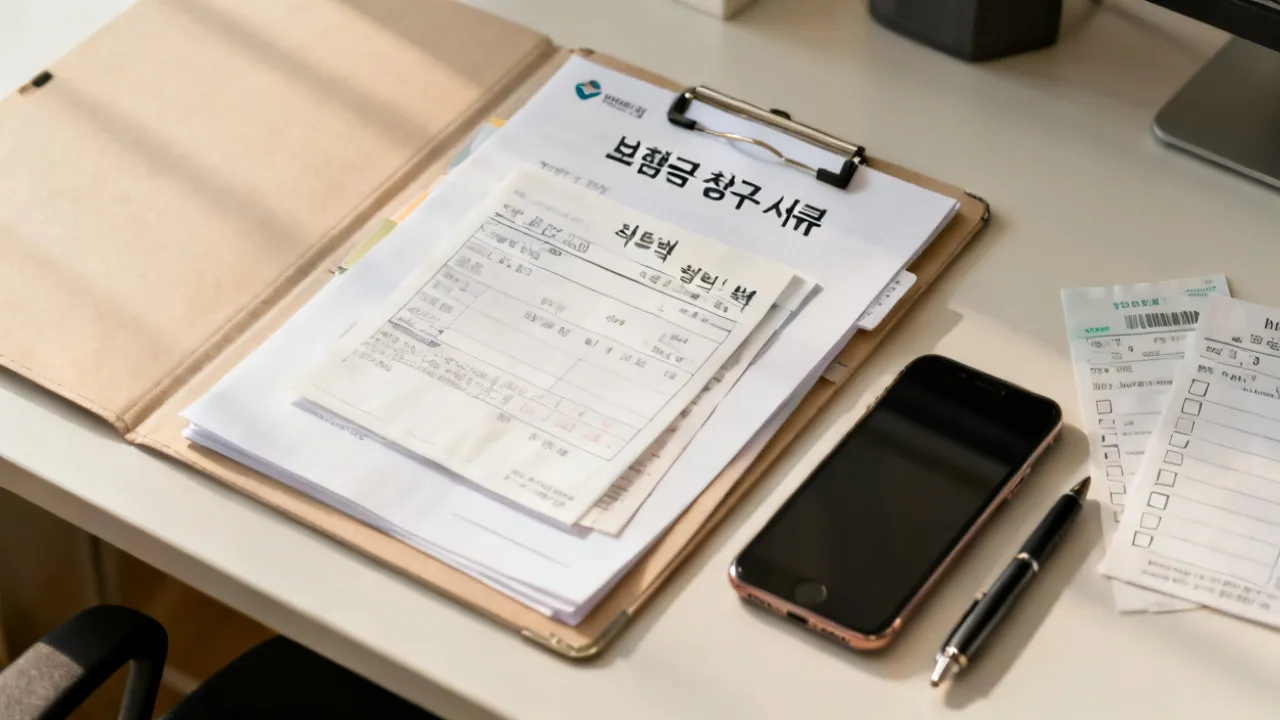
When an insured event occurs, the quality and relevance of the submitted documentation often determine whether an insurer can assess the claim promptly. The central task is not to provide the largest possible volume of paperwork. It is to submit documents that clearly establish five points: who is claiming, what happened, when it happened, what financial or medical loss resulted, and how the requested payment is connected to the policy coverage.
The Korean expression 보험금 청구 서류 refers broadly to the documents used to request insurance benefits. The exact list is not universal. A hospital expense claim may require medical records and payment evidence, while a property claim may depend on photographs, repair estimates, purchase records, and an incident report. A life insurance claim may require death-related documentation, beneficiary information, and proof of relationship or authority.
From an insurance administration perspective, applicants should begin with the insurer’s official claim checklist for the specific product. Policyholders should also confirm whether the claim concerns private insurance, a group policy, travel insurance, automobile insurance, or another category. Similar events can have materially different documentation requirements under different contracts.
Core document categories
- Identity and authority: identification, claimant details, and documents showing that the person submitting the claim is entitled to do so.
- Claim information: the insurer’s claim form, policy number, contact details, and a description of the incident.
- Occurrence evidence: medical records, police reports, accident reports, photographs, or other records confirming that the insured event occurred.
- Financial evidence: receipts, invoices, payment confirmations, repair estimates, wage-loss records, or other documents showing the amount at issue.
- Coverage-related evidence: materials that help the insurer determine whether the event falls within the insured risk and whether exclusions or limits apply.
- Authority and relationship evidence: family relationship records, beneficiary records, powers of attorney, guardianship documents, or business authorization where relevant.
A frequent mistake is to treat the document list as a fixed administrative formality. In reality, it functions as an evidence package. Each document should contribute to a coherent explanation of the claim. If a receipt shows a payment but does not identify the patient, service, or date, it may not adequately support a medical claim. If photographs show property damage without establishing ownership or the date of the loss, the insurer may request additional evidence.
The applicant should therefore think in terms of a logical chain. The policy identifies the insured relationship. The medical, accident, or incident record establishes what happened. The invoice or receipt establishes the financial consequence. The policy wording explains why that consequence may be payable. When these parts are consistent, the claims reviewer can understand the file more efficiently.
Why Document Requirements Vary
Insurance contracts are designed around different risks. Health policies address diagnoses, treatments, hospitalization, surgery, prescription costs, or disability. Automobile policies address collisions, vehicle damage, bodily injury, and liability. Property policies may cover fire, water damage, theft, or other specified events. Travel policies can involve delayed transportation, baggage loss, medical treatment abroad, or cancellation.
Because the insured risk changes, the supporting evidence changes as well. The same hospital visit may require different documents depending on whether the policy covers actual medical expenses, a fixed daily hospitalization benefit, surgery, a specific diagnosis, or a combination of benefits. Likewise, a vehicle repair claim may be assessed under collision coverage, liability coverage, or a separate roadside assistance provision.
Policy wording is therefore more important than general online checklists. General guidance can help an applicant understand the process, but it cannot replace the contract, the insurer’s current submission rules, or a request from the claims department. Insurers may also apply different requirements according to the size and complexity of the claim, the claimant’s relationship to the insured person, and the circumstances of the event.
Common factors that influence the checklist
| Factor | Why it matters | Typical documentation focus |
|---|---|---|
| Insurance product | Different products protect against different risks. | Medical records, accident evidence, property records, or travel documents. |
| Type of claim | A diagnosis, hospitalization, death, theft, and vehicle collision require different proof. | Records that establish the event, date, cause, and financial effect. |
| Claimant status | The insured person, beneficiary, guardian, business, or authorized representative may submit the claim. | Identification, relationship documents, authorization, or corporate records. |
| Claim amount | Larger or more complex claims may require more detailed verification. | Detailed invoices, expert opinions, estimates, or additional reports. |
| Policy conditions | Deductibles, exclusions, waiting periods, and limits can affect the assessment. | Evidence relevant to the specific coverage and contractual conditions. |
| Submission method | Online, mobile, postal, and in-person channels can have different technical or original-document requirements. | File formats, signatures, identity verification, and original records. |
Document requirements can also change after the initial submission. An insurer may begin with a basic review and later request a more specific medical record, an explanation of a date, or proof of ownership. This does not automatically mean the claim is being treated negatively. It may simply mean that the first set of documents did not answer a particular coverage question.
The Basic Structure of 보험금 청구 서류
Although every claim is different, a well-organized submission commonly contains several layers. Understanding these layers helps prevent missing information and reduces the need to send scattered documents over multiple rounds.
1. Claim form
The claim form identifies the policy, claimant, insured person, incident, and payment details. It may also include a consent section concerning the collection and use of personal information. Applicants should complete every relevant field and avoid unexplained abbreviations. If a question does not apply, it is generally clearer to mark it as not applicable rather than leave it ambiguous, provided that the insurer’s form permits this approach.
The incident description should be factual and chronological. It should state what happened, when it happened, where it happened, what treatment or repair followed, and what amount is being claimed. The description should not speculate about legal responsibility or medical conclusions beyond the available records.
When the form asks for a diagnosis, procedure, or cause, the applicant should use the wording shown in the official record where possible. A personal description such as “serious stomach problem” may be understandable but less useful than the precise diagnosis recorded by the medical institution. Similarly, “the ceiling leaked” may need to be supplemented with information about when the leak was discovered, who inspected it, and what damage resulted.
2. Identification and payment information
Insurers generally need to confirm the identity of the person receiving the benefit. The exact documents can differ according to the submission channel and claim type. A claimant may need identification details, an account in the appropriate name, or evidence of authority when submitting on behalf of another person.
Extra care is necessary for minors, deceased insured persons, persons under guardianship, and business policyholders. In these situations, the insurer may request family relationship documents, guardianship evidence, beneficiary information, corporate registration materials, or a power of attorney. The applicant should not assume that a family relationship alone will automatically satisfy every procedural requirement.
Payment information should be checked carefully. A typographical error in the account number, the use of an account belonging to an unauthorized person, or a mismatch between the claimant and account holder can delay payment even after coverage has been accepted. If the insurer has a specific form for account confirmation, that form should be completed according to its instructions.
3. Records confirming the event
The insurer needs reliable evidence that the insured event occurred. For a medical claim, this may involve a diagnosis certificate, treatment record, medical certificate, operation record, discharge summary, or other clinical document. For a traffic accident, the relevant evidence may include an accident report, repair assessment, photographs, statements, or records from the insurer handling the vehicle claim.
For property loss, evidence might include photographs taken before repairs, purchase receipts, ownership records, repair estimates, and documentation from public authorities or building management when relevant. For theft, a police report may be important. For travel-related disruption, the carrier’s confirmation of delay, cancellation, or baggage irregularity may be necessary.
The best evidence usually comes from a neutral or official source, such as a hospital, police department, transport company, repair business, building manager, or public authority. Personal statements remain useful, especially for explaining circumstances, but they may not replace records that independently confirm the event.
4. Evidence of the amount claimed
Establishing that an event occurred does not always establish the amount payable. Receipts, invoices, payment confirmations, itemized bills, repair estimates, and other financial records help connect the event to the claimed amount. Documents should ideally show the date, provider, service or item, amount, and payer.
A bank transaction record can help confirm payment, but it may not explain what was purchased. Conversely, an itemized invoice may explain the service but not prove that the claimant paid it. Depending on the claim, both types of evidence may be useful.
Applicants should distinguish between an estimate and a final invoice. An estimate may show the anticipated cost of repairs, while a final invoice shows the amount actually charged. Some claims are assessed using the estimate, but the insurer may later request the final invoice or proof of settlement. If a repair has not yet been completed, the applicant should clearly state that the submitted amount is an estimate.
Medical Claims: Documents That Commonly Matter
Medical claims are among the most common reasons people search for 보험금 청구 서류. They are also an area where applicants frequently submit either too little information or documents that are not suited to the benefit being requested.
The first step is to identify the benefit category. A claim for outpatient treatment may focus on the treatment date, diagnosis, itemized medical charge, and payment evidence. A hospitalization claim may require admission and discharge dates, a discharge summary, and medical documentation explaining the treatment. A surgery benefit may require an operation record or a medical certificate that identifies the procedure. A diagnosis benefit may require a document that uses the relevant diagnostic terminology or code specified by the policy or insurer.
Medical document categories
- Medical certificate: may identify the diagnosis, treatment period, or medical opinion, depending on the form.
- Diagnosis confirmation: may be relevant when a policy pays according to a defined diagnosis or disease category.
- Medical treatment record: can describe the consultation, treatment, procedure, or clinical findings.
- Discharge summary: may confirm hospitalization dates, diagnosis, treatment, and discharge status.
- Operation record: can help verify the nature and date of a surgical procedure.
- Itemized bill: identifies charges by service, medicine, procedure, or material.
- Payment receipt: supports the fact and amount of payment.
- Prescription or pharmacy record: may be relevant to medication-related benefits, subject to policy terms.
- Examination or test result: may be relevant when the benefit depends on a particular diagnosis or clinical finding.
Not every medical claim requires every item listed above. Requesting a document from a medical institution can involve a fee and administrative time, so the applicant should first review the insurer’s requirements. If the insurer requests a medical certificate, a simple payment receipt may not be an adequate substitute. If the benefit concerns actual expenses, an itemized statement and payment evidence may be more important than a broad narrative certificate.
Medical information is sensitive personal data. Applicants should send it through the insurer’s designated secure channel and limit disclosure to the information reasonably necessary for claim assessment. They should also verify the recipient before sending documents by email, mobile application, post, or in person.
Outpatient treatment claims
For outpatient treatment, applicants often need a record showing the treatment date and type of service, together with the itemized medical charge and payment receipt. Some policies require information about the diagnosis or disease code, while others focus primarily on actual expenses. If several visits relate to the same condition, it may be useful to arrange the records by date and separate each visit’s payment evidence.
A prescription alone may not prove that the medicine was purchased, and a pharmacy receipt may not establish why the medicine was prescribed. Where medication coverage is involved, the prescription and payment record may therefore work together. The applicant should check whether non-prescription products, supplements, medical devices, or excluded items are treated differently under the policy.
Hospitalization and surgery claims
Hospitalization claims usually require clear admission and discharge information. A payment receipt can establish that a charge was paid, but it may not establish the length of the admission or whether the stay meets the policy’s definition of hospitalization. A discharge summary or medical record may address those issues.
Surgery benefits can depend on the exact procedure performed. Procedures that appear similar in everyday language may be classified differently under a policy. An operation record, procedure report, or medical certificate using the institution’s official terminology can help the insurer compare the treatment with the policy definition. Applicants should not alter or paraphrase the clinical description to make it appear closer to a benefit category.
Accident and Property Claims
Accident and property claims often depend on preserving evidence quickly. Damage can change after cleaning, repair, disposal, or relocation. Applicants should photograph the overall scene and close-up details, record the date and location, and preserve damaged items when practical and safe. Photographs alone may not establish ownership, cause, or repair cost, so they should be combined with other records.
Vehicle-related claims
For a vehicle accident, useful materials may include the policy information, accident description, photographs, repair estimate, repair invoice, police documentation where applicable, and information concerning other parties. The insurer may already possess some information through its own claims process, but applicants should still follow the specific instruction provided by the relevant claims representative.
Photographs should show the position of the vehicles where safe, the surrounding road or location, license plates when appropriate, and close-up views of the damage. Applicants should avoid placing themselves or others in danger to obtain evidence. If the police, emergency service, or another authority has already documented the scene, that official record may be more useful than attempting to recreate the scene later.
Applicants should avoid authorizing extensive repairs before checking whether the insurer requires an inspection or prior notification. This is not a universal rule, and emergency measures may be necessary to prevent further damage. The practical principle is to preserve evidence, document urgent action, and communicate with the insurer as soon as reasonably possible.
Home and property claims
Property claims may require evidence of ownership, the condition of the item, the cause of damage, and the cost of restoration or replacement. Depending on the policy, the insurer may distinguish between repairable damage, total loss, depreciation, and excluded causes.
For water damage, records from building management, plumbers, or repair contractors may help identify the source and scope of the incident. For fire damage, an official incident record and repair assessment may be relevant. For theft, a police report and a list of missing items can provide a structured account of the loss. Purchase records, photographs, warranty records, and account statements may help support ownership and value.
Before discarding a damaged item, applicants should ask whether the insurer wants to inspect it. If disposal is necessary for health, safety, or sanitation reasons, photographs, contractor statements, and receipts should be retained. The applicant should also document temporary measures, such as emergency drying, boarding, or storage, because those costs may be treated separately from the primary repair.
Life, Disability, and Beneficiary Claims
Life and disability claims can involve more sensitive documentation and a more complex relationship between the policyholder, insured person, beneficiary, and claimant. The insurer may need to confirm the event, the beneficiary’s status, and the authority of the person submitting the request.
A death benefit claim commonly involves a claim form, identification, death-related documentation, beneficiary information, and documents establishing the relationship or entitlement where required. A disability claim may involve medical certificates, examination results, treatment records, and evidence that the disability meets the policy’s definition. The contract may distinguish between temporary impairment, permanent disability, occupational incapacity, and a specific loss of function.
Applicants should read the policy definition carefully. A diagnosis by itself may not prove that the contractual definition of disability has been met. Similarly, an inability to work for a short period may not be treated in the same way as a benefit based on a permanent impairment. Medical evidence should address the relevant facts without asking a clinician to make a legal or contractual determination that falls outside the clinical role.
Beneficiary claims may involve several people with potentially different interests. If there is more than one beneficiary, the insurer may require separate payment instructions or additional confirmation. Where a beneficiary is a minor or cannot act independently, authority documents may be necessary. Applicants should obtain the insurer’s specific instructions before submitting family or estate-related records.
Travel Insurance and Overseas Documentation
Travel insurance claims may involve records issued in another country or language. Applicants should retain original receipts, medical invoices, prescriptions, airline or transport confirmations, baggage reports, and cancellation notices. If a document is not in Korean or another language accepted by the insurer, the claims department may explain whether a translation or additional certification is needed.
For overseas medical treatment, the applicant should record the provider’s name, treatment date, diagnosis or reason for treatment, amount paid, currency, and payment method. Currency conversion is generally handled according to the insurer’s rules or the relevant policy terms. Applicants should not assume that a personal calculation will be accepted without supporting financial information.
For baggage loss or damage, the carrier’s irregularity report can be particularly important. For a delayed or cancelled journey, the transport provider’s written confirmation may establish the event more clearly than a personal statement alone. Travel itineraries, booking confirmations, and proof of the insured trip can also be relevant.
Applicants should report a loss to the airline, hotel, local authority, or other responsible organization as soon as possible when the policy or circumstances call for it. A later personal statement may describe the incident, but a contemporaneous report often provides stronger evidence of timing and condition. Receipts for emergency clothing, transportation, lodging, or replacement necessities should be separated from ordinary travel expenses.
Step-by-Step Process for Submitting a Claim
A disciplined process is usually more effective than collecting documents at random. The following sequence reflects common claims-management practice, but the insurer’s own instructions take priority.
-
Identify the policy and benefit.
Confirm the insurer, product, policy number, insured person, and benefit potentially triggered by the event. If several policies may respond, review each separately rather than assuming that one document list applies to all.
-
Record the event promptly.
Write down the date, location, people involved, immediate response, medical or repair action, and current status. For property or accident claims, preserve photographs and other evidence before conditions change.
-
Obtain the insurer’s current checklist.
Use the insurer’s application, claims portal, customer service channel, or branch guidance. Ask whether the checklist changes according to the benefit, amount, claimant status, or submission method.
-
Separate required documents from conditional documents.
Some materials are needed in almost every claim, while others apply only to a particular situation. Mark documents that may be requested if the insurer needs further verification.
-
Check consistency.
Compare names, dates, policy numbers, treatment periods, addresses, and amounts across all documents. Small discrepancies can cause delays because the insurer may need to determine whether they reflect a simple clerical error or a substantive inconsistency.
-
Submit through an approved channel.
Follow the insurer’s instructions for mobile submission, website upload, postal delivery, branch submission, or another method. Keep a record of the submission date and the documents sent.
-
Monitor requests for supplementation.
If the insurer asks for additional materials, identify exactly what question the request addresses. Respond with the requested document and a short explanation when useful, rather than sending unrelated records.
-
Review the decision notice.
Check the approved amount, excluded amount, deductible, policy basis, and any explanation provided. If the result is unclear, request a written explanation and compare it with the policy terms.
Comparison Table: Document Needs by Claim Type
| Claim type | Primary evidence | Additional evidence that may be requested | Main point to verify |
|---|---|---|---|
| Outpatient medical treatment | Claim form, treatment record or receipt, itemized bill, payment evidence | Diagnosis confirmation, prescription, treatment details | Whether the treatment and expense fall within the coverage |
| Hospitalization | Claim form, admission and discharge evidence, itemized bill, payment evidence | Discharge summary, medical record, operation record | Hospitalization period, medical necessity, and applicable benefit |
| Surgery | Claim form, operation record or medical certificate, itemized charges | Pathology report, treatment record, diagnosis confirmation | Whether the procedure matches the policy definition |
| Traffic accident | Accident description, photographs, repair estimate or invoice | Police report, witness information, liability records | Cause, responsibility, damage, and policy coverage |
| Property damage | Photographs, incident description, repair estimate or invoice | Ownership evidence, contractor report, building management record | Cause of loss, extent of damage, and exclusions |
| Theft | Incident report, loss list, ownership evidence | Police report, purchase records, photographs | Occurrence, ownership, and covered property |
| Death benefit | Claim form, identification, death-related documentation | Beneficiary or relationship documents, authority documents | Beneficiary entitlement and policy conditions |
| Travel disruption | Travel booking, carrier confirmation, receipts | Baggage report, medical records, cancellation explanation | Covered cause, travel dates, and actual financial loss |
| Disability benefit | Claim form, medical certificate, relevant treatment records | Examination results, work records, functional assessment | Whether the condition satisfies the contractual definition |
How to Organize Documents Before Submission
Organization is a practical form of risk control. Applicants should create a simple document index listing the file name, document type, date, issuing institution, and purpose. A chronological order is usually effective for accident and medical claims. For property claims, an order based on cause, damaged item, ownership, and repair cost may be clearer.
Scanned documents should be legible, complete, and oriented correctly. Each page should be checked for cut-off text, hidden fields, unclear stamps, and missing attachments. If an application requires a signature, the signature should be placed in the designated area. A photograph of a document may be accepted by one channel but rejected by another if the text cannot be read.
File names should be descriptive without exposing unnecessary personal information. Examples include “claim-form,” “hospital-discharge-summary,” “itemized-medical-bill,” or “property-damage-photo-01.” Applicants should retain the original documents when the insurer permits digital submission and should avoid altering photographs or records in a way that could raise questions about authenticity.
A useful document index
| Order | Document | Date | Purpose |
|---|---|---|---|
| 1 | Completed claim form | Submission date | Identifies the claim and requested benefit |
| 2 | Identification or authority document | Current date | Confirms claimant identity or authority |
| 3 | Event confirmation | Date of incident or treatment | Establishes what occurred |
| 4 | Financial evidence | Payment or invoice date | Supports the amount claimed |
| 5 | Supplementary explanation | Submission date | Clarifies unusual facts or discrepancies |
A document index is especially helpful when a claim includes numerous receipts or several treatment dates. The applicant can number each receipt and refer to those numbers in the claim form or cover note. This makes it easier to identify which expense relates to which event. It also helps the applicant notice if an invoice is missing its matching payment record.
Common Reasons for Additional Document Requests
An additional request does not necessarily mean that the claim will be rejected. It usually indicates that the insurer needs to resolve a question before reaching a decision. The request may concern identity, timing, causation, medical classification, ownership, payment, or the relationship between the event and the policy coverage.
Unclear dates
Dates may differ between a receipt, treatment record, accident description, and claim form. A one-day difference can result from administrative processing, but the applicant should explain it when relevant. For hospitalization, admission and discharge dates should be consistent across the documents or accompanied by a clear explanation.
Insufficient detail
A general diagnosis or a broad invoice may not answer the specific question raised by the policy. If the benefit depends on a particular procedure, degree of impairment, or cause of damage, the insurer may request a document that addresses that point directly.
Missing payment evidence
Applicants sometimes provide an invoice but not proof that the amount was paid. In other cases, they provide a bank record without an itemized description. The insurer may seek both because the two records establish different facts.
Unclear authority
When one person submits a claim for another, the insurer may need evidence of consent or legal authority. This is particularly relevant when the insured person is a minor, deceased, incapacitated, or represented by a business or institution.
Possible policy exclusion
If the circumstances relate to an exclusion, waiting period, pre-existing condition, intentional act, occupational activity, or another contractual limitation, the insurer may request more detailed records. The applicant should answer accurately and should not omit information simply because it appears unfavorable.
Inconsistent descriptions
A claim form may describe an event differently from a police report, medical record, or repair estimate. Differences in wording are not always significant, but major inconsistencies can make it difficult to determine the cause of the loss. Applicants should explain whether different descriptions reflect different perspectives, translation issues, or an initial misunderstanding.
Conditions and Requirements Applicants Should Check
Before submitting 보험금 청구 서류, applicants should review the following conditions. These are general considerations rather than a substitute for the specific policy.
- Coverage period: Confirm that the event or treatment falls within the policy’s effective period.
- Insured person: Check that the person who experienced the event is the person covered by the relevant benefit.
- Notification requirement: Determine whether the policy or insurer asks for prompt notice of an accident, hospitalization, theft, or property damage.
- Claim deadline: Review the applicable contractual and legal time limits. If uncertain, contact the insurer promptly rather than waiting for every document to be collected.
- Deductible: Establish whether the amount claimed is reduced by a deductible or other contractual adjustment.
- Benefit limit: Confirm annual, incident-based, item-based, or lifetime limits where applicable.
- Exclusions: Review events, conditions, treatments, activities, or circumstances excluded by the policy.
- Duplicate coverage: If several policies may cover the same expense, ask how coordination or proportional payment is handled under the relevant contracts.
- Authorized claimant: Verify who may submit the claim and who may receive the payment.
- Submission channel: Confirm file size, format, signature, identity verification, and other channel-specific rules.
- Personal information: Send sensitive records only through an insurer-approved method and check the recipient carefully.
- Original documents: Determine whether the insurer requires originals, certified copies, or only readable scans.
These requirements are especially important for medical claims because the same treatment may be covered under one benefit and excluded or limited under another. The applicant should distinguish between “the treatment occurred” and “the policy pays for this treatment under these conditions.” That distinction is central to sound claim preparation.
Digital Submission and Paper Submission
Many insurers provide digital claim channels, but available functions vary by insurer, product, claim type, and amount. Digital submission can make it easier to upload photographs, receipts, and forms, while paper submission may be appropriate when original documents, signatures, or complex supporting records are requested.
Before uploading, applicants should check whether the system accepts PDF, image files, or other formats. They should confirm that all pages are included and that the image is readable at normal viewing size. Screenshots can omit important information, and compressed images may make text or seals difficult to verify.
For paper submissions, applicants should make copies or scans for their own records. If sending important documents by post, they should use a delivery method that provides a record of dispatch when appropriate. The package should identify the policy or claim reference in the manner requested by the insurer.
Security is part of documentation quality. Medical certificates, identification documents, bank details, and family relationship records should not be posted in public forums or sent to unverified contacts. If a third party is assisting with the claim, the applicant should understand what authority that party has and what information will be shared.
Digital systems may also have practical limits. A portal might restrict the number of files, maximum file size, or number of pages submitted at once. If several documents are combined into one file, the applicant should arrange them in a logical order and use bookmarks or a contents page when the file is lengthy. If the system fails, take a screenshot of the error where appropriate and contact the insurer rather than repeatedly submitting incomplete files.
Industry Expert Perspective: Building a Clear Evidence Chain
From an industry expert’s perspective, the strongest claim file is not necessarily the longest one. It is the file in which each major assertion can be traced to a relevant record. A useful evidence chain can be expressed as follows:
Policy relationship → insured event → date and cause → resulting loss → claimed amount → coverage basis.
For example, a medical expense claim should connect the insured person to the policy, the treatment date to the covered period, the diagnosis or treatment to the insured benefit, and the payment receipt to the amount requested. A property claim should connect the claimant to the property, the incident to the covered cause, the photographs to the damage, and the repair invoice to the financial loss.
This approach also improves communication with the claims department. Rather than sending a long narrative, an applicant can prepare a short cover note:
Incident: What happened and when.
Effect: What treatment, repair, or financial loss followed.
Requested benefit: The specific policy benefit being claimed.
Attached evidence: A numbered list of documents supporting each point.
The cover note should remain factual. It should not misstate the event, pressure the reviewer to reach a particular conclusion, or include unsupported assumptions. A concise, accurate explanation generally serves the applicant better than emotional or speculative language.
For complicated claims, a timeline can be more useful than several pages of prose. A medical timeline might list the first symptom, consultation, examination, diagnosis, procedure, admission, discharge, and payment dates. An accident timeline might list the incident, emergency response, notification to the insurer, inspection, estimate, repair, and payment. The timeline should identify the document supporting each important entry.
What to Do If the Insurer Requests More Information
Read the request carefully and identify whether it asks for a replacement document, an additional document, clarification, or authorization. If the wording is unclear, contact the insurer and ask what issue the document is intended to resolve. This question can prevent the applicant from obtaining an unsuitable record.
When responding, refer to the claim number and list each attached document. If a requested record cannot be obtained, explain why and ask whether an alternative is acceptable. The applicant should keep copies of the response and note the date of submission.
If there is a factual error in the insurer’s request, the applicant should correct it calmly with supporting evidence. For example, if the insurer refers to the wrong treatment date, the applicant can identify the correct date and attach the record showing it. A documented correction is more useful than a general statement that the request is mistaken.
Applicants should also pay attention to response deadlines stated in the request. If more time is needed to obtain a medical or official record, contact the insurer before the deadline and ask whether an extension or interim explanation is possible. Silence can create avoidable uncertainty, whereas a timely explanation demonstrates that the applicant is actively addressing the request.
Handling a Disputed or Rejected Claim
If an insurer declines a claim or pays less than expected, the first step is to obtain the reason in clear, written terms. The decision may rely on a coverage exclusion, a benefit definition, insufficient evidence, a deductible, a limit, or a finding that the event does not meet the policy conditions.
Compare the explanation with the policy schedule, special conditions, endorsements, and relevant claim documents. Pay attention to definitions because ordinary language and contractual language may differ. A policy may define hospitalization, surgery, disability, accident, or covered treatment in a specific way.
If the applicant believes that important evidence was overlooked, submit a structured reconsideration request. Identify the disputed point, cite the relevant document by date and page, and explain how it addresses the insurer’s stated reason. The applicant may also use the insurer’s internal complaint or review process and, where appropriate, consult an authorized professional or the relevant Korean dispute-resolution institution.
Official guidance from bodies such as Korea’s Financial Supervisory Service can help consumers understand financial complaint and dispute procedures. Applicants should use the current official information available at the time of the dispute because procedures and contact channels can change. General guidance does not determine the outcome of an individual claim.
A reconsideration request should distinguish between disagreement with the facts and disagreement with the policy interpretation. If a date, amount, or diagnosis has been recorded incorrectly, the applicant should provide corrective evidence. If the facts are accepted but the applicant believes the policy has been interpreted incorrectly, the request should identify the relevant wording and explain why the benefit should apply. This distinction makes the review easier to follow.
Privacy and Record-Keeping
보험금 청구 서류 may contain highly sensitive information. Good record-keeping should therefore include both completeness and privacy protection. Keep a private copy of submitted documents, the submission date, confirmation number, correspondence, and the name or department of the person contacted.
Applicants should avoid sending more personal information than necessary. If an insurer requests a particular medical record, the applicant can ask whether a narrower record is sufficient. The insurer may have a legitimate need to review relevant information, but the purpose and scope of the request should be understood.
Documents should be stored securely, especially identification copies, bank information, medical records, and family relationship documents. When using a shared computer or public network, applicants should log out and remove downloaded files when appropriate. They should also check the address and application domain before entering personal information into an online claims system.
When using cloud storage, applicants should select a private account and avoid sharing links with unrestricted access. If documents are printed, they should be stored where visitors or unauthorized household members cannot access them. Once the claim is completed and any review period has passed, applicants should consider securely disposing of unnecessary copies rather than placing sensitive records intact in ordinary recycling.
Practical Checklist Before Pressing Submit
Final review checklist
- Have you identified the correct insurer and policy?
- Is the insured person’s name consistent across the documents?
- Is the claimant authorized to submit the claim?
- Does the claim form describe the event accurately and chronologically?
- Are the incident, treatment, admission, repair, or payment dates clear?
- Are receipts and invoices itemized where relevant?
- Does payment evidence correspond to the claimed expense?
- Are photographs clear, dated where possible, and connected to the loss?
- Have you checked the policy limit, deductible, waiting period, and exclusions?
- Have you followed the insurer’s current submission method?
- Have you saved a copy of every submitted file?
- Have you kept the submission confirmation and claim reference?
- Have you checked that signatures, consent sections, and required attachments are complete?
- Have you removed unrelated personal information where appropriate?
Sources and Reliable Reference Points
Applicants should treat the policy contract and the insurer’s current claims guidance as the primary sources for document requirements. For broader consumer information in Korea, relevant reference points may include the Financial Supervisory Service, the Korea Consumer Agency, and the National Health Insurance Service, depending on the nature of the issue.
The National Health Insurance Service concerns Korea’s public health insurance administration and should not be confused with the payment rules of private insurance products. A document used for public medical reimbursement may not automatically satisfy a private insurer’s requirements. Similarly, guidance from a regulator or consumer organization can explain general rights and procedures but does not replace the terms of an individual contract.
When reviewing information, confirm the publication date and whether it applies to the relevant insurance category. Product terms, digital submission rules, privacy notices, and claim procedures may be updated. If an online article conflicts with the insurer’s current written instruction or the policy wording, applicants should ask the insurer for clarification and retain the response.
Employers, hospitals, travel agencies, repair businesses, and family members may also provide practical assistance, but their advice should be distinguished from the insurer’s formal requirements. A hospital may explain how to obtain a medical record, while only the insurer can confirm whether that record satisfies a particular benefit. A repair contractor may estimate damage, while the insurer determines how the estimate is treated under the policy.
Frequently Asked Questions
What does 보험금 청구 서류 mean?
보험금 청구 서류 means the documents submitted to request insurance benefits. The phrase can cover claim forms, identification, medical or incident records, receipts, invoices, photographs, authority documents, and other evidence. The required combination depends on the policy and the type of claim.
Is one document checklist suitable for every insurance claim?
No. A checklist for outpatient treatment will not necessarily apply to a death benefit, vehicle accident, theft, property loss, or travel disruption. The insurer, product, benefit, claimant status, and claim circumstances all influence the required documents.
Do medical claims always require a medical certificate?
No. Some claims may be assessed using treatment records, itemized bills, payment receipts, prescriptions, or other medical documentation. A medical certificate may be requested when the benefit depends on a diagnosis, surgery, hospitalization, disability, or another defined condition. Confirm the requirement before requesting records from the medical institution.
Is a receipt enough to prove a medical expense?
Not always. A receipt may prove payment but may not show the diagnosis, treatment, service details, or patient identity required for assessment. The insurer may request an itemized bill or medical record as well. The appropriate documents depend on the benefit and the policy wording.
Can a family member submit a claim for another person?
In some circumstances, yes, but the insurer may require proof of authority, relationship, consent, guardianship, or beneficiary status. Requirements can be stricter for minors, deceased insured persons, and persons who cannot submit the claim themselves.
What should I do if I cannot obtain a requested document?
Contact the insurer and explain the reason. Ask whether an alternative record, an issuing institution’s confirmation, or another form of evidence can be accepted. Do not substitute a different document without explaining the situation, because the insurer may not know whether the substitute addresses the same issue.
Should I submit every document I have?
Not necessarily. Relevant and legible documents are generally more useful than an unorganized collection of unrelated materials. Submit the items listed by the insurer and add a concise explanation when unusual facts require clarification. Keep a private record of all materials sent.
What if the dates on my documents do not match?
Check whether the difference reflects a genuine administrative distinction, such as the treatment date versus the billing date. If the difference is material, explain it in the claim submission and identify the document that confirms the correct date. Unexplained inconsistencies can lead to additional questions.
Can I repair damaged property before the insurer reviews it?
Urgent action may be necessary to protect people or prevent further damage. When possible, photograph the condition first, preserve damaged items, retain invoices, and notify the insurer promptly. Whether prior inspection or approval is required depends on the policy and claim procedure.
How should overseas documents be submitted?
Keep the original invoices, receipts, treatment records, transport confirmations, and incident reports. Ask the insurer whether translation, certification, or a particular format is needed. Record the currency, payment date, provider, and purpose of each expense.
What should I do after a claim is rejected?
Request the reason in writing, compare it with the policy terms, and identify whether the issue concerns an exclusion, definition, limit, deductible, or missing evidence. If relevant evidence was overlooked, submit a structured review request. You may also use the insurer’s complaint process or seek guidance from an appropriate consumer or dispute-resolution body.
Are digital copies accepted?
Many insurers accept digital files through designated channels, but acceptance depends on the insurer, claim type, document, and submission method. Check file format, size, image quality, signature, and original-document requirements before uploading or sending a scan.
How long should I keep claim records?
Applicants should retain the claim form, submitted evidence, insurer correspondence, payment confirmation, and decision notice for a reasonable period, particularly if the policy has continuing benefits or a review remains possible. The applicable retention period may depend on the claim type, contract, and legal circumstances. When uncertain, ask the insurer how long relevant records should be preserved.
Can I claim the same expense under multiple policies?
Several policies may respond to the same event, but the treatment of overlapping benefits depends on the policy type and contract terms. Fixed-benefit coverage and actual-expense coverage may operate differently. Applicants should disclose relevant information accurately and ask the insurers how coordination or duplicate reimbursement is handled.
Conclusion
Preparing 보험금 청구 서류 is best understood as a process of establishing facts rather than simply completing paperwork. The applicant should identify the correct policy benefit, document the event, support the resulting loss, and present the evidence in a consistent order. Medical, accident, property, life, disability, and travel claims each require different forms of proof.
The most reliable approach is to begin with the insurer’s current checklist, read the relevant policy wording, preserve evidence promptly, and maintain a clear record of submission and correspondence. Applicants should protect sensitive personal information, respond accurately to additional requests, and seek written clarification when a decision is difficult to understand. With careful preparation, the claim file becomes easier to review and the applicant is better positioned to understand how the policy applies to the particular event.
Good preparation does not guarantee that a claim will be approved, because the final result depends on the contract, the facts, and the insurer’s assessment. It does, however, reduce avoidable delays and make the applicant’s position clearer. A complete and well-ordered submission allows the insurer to focus on the actual coverage question instead of spending time resolving preventable problems involving identity, dates, payment, authority, or missing evidence.