Understanding 비급여 실비 Insurance Claims
This guide explains how 비급여 실비, meaning reimbursement for non-covered medical expenses under Korean indemnity health insurance, is assessed, documented, and claimed. It distinguishes National Health Insurance coverage from non-covered treatment, examines policy conditions, deductibles, exclusions, medical necessity, and claim documents, and outlines a careful review process. Actual reimbursement depends on the policy generation, contract wording, treatment records, provider documents, and applicable review standards, so readers should confirm the final decision with their insurer and relevant official institutions.
What 비급여 실비 Means in Korea
비급여 실비 is a Korean search term commonly used when people want to understand whether a medical expense that falls outside National Health Insurance coverage can be reimbursed through private indemnity health insurance. The expression combines 비급여, meaning a medical service not covered by the National Health Insurance system, with 실비, a shortened reference to indemnity-style insurance that reimburses eligible medical costs according to the policy contract.
The term is useful, but it can also create confusion. A non-covered charge is not automatically reimbursable. Private insurance and National Health Insurance are separate systems with different rules, payment structures, exclusions, deductibles, claim procedures, and review standards. A hospital may classify a service as 비급여, while an insurer may later determine that the expense is excluded, insufficiently documented, subject to a limit, or payable only after a deductible is applied.
The central question is therefore not simply, “Is this treatment non-covered?” The more accurate question is, “Does this particular policy cover this particular non-covered expense, under the contract terms and medical circumstances that existed when the treatment occurred?” That distinction should guide every review of a 비급여 실비 claim.
It is also helpful to understand that 실비 insurance is not a general medical-expense subsidy. It is a private contract designed to compensate certain losses or expenses within agreed boundaries. The insurer does not normally decide coverage based only on the fact that the patient paid money at a hospital. Instead, it examines the nature of the treatment, the reason it was provided, the policy terms, and the supporting documents. The same service can therefore produce different results for different policyholders.
Executive Summary: The Most Important Points
- Non-covered does not mean automatically reimbursable. The insurance policy, treatment purpose, medical records, exclusions, limits, and deductible all matter.
- Policy generation is important. Older and newer indemnity insurance products may apply different benefit structures and conditions.
- Medical necessity must be clear. A prescription, examination, procedure, or therapy may require supporting records explaining why it was clinically indicated.
- Documents should match one another. The receipt, detailed billing statement, diagnosis information, prescription, and treatment record should describe the same service and date.
- Claim timing and submission channels vary. Insurers may accept mobile, electronic, postal, or in-person submissions, but document requirements depend on the claim.
- A small claim may not produce a payment. Deductibles, minimum claim thresholds, exclusions, and benefit limits can reduce or eliminate the reimbursable amount.
- Insurer explanations should be reviewed carefully. If a claim is reduced or declined, request the contractual basis and the specific missing or conflicting evidence.
- Official confirmation is preferable to assumptions. Consumers can consult their insurer, the Financial Supervisory Service, the Korea Insurance Development Institute, and relevant health-insurance authorities for current guidance.
- Keep the policy and medical records together. A claim is easier to understand when the policy terms, invoice, medical explanation, and claim response can be reviewed as one file.
- Coverage and reimbursement amount are separate questions. Even an eligible treatment can result in a limited payment after deductibles, category limits, and excluded portions are applied.
National Health Insurance and Private Indemnity Insurance
To understand 비급여 실비, it helps to separate three financial categories that often appear on one hospital bill.
- National Health Insurance-covered costs: These are services recognized within the public health-insurance framework. The patient generally pays the applicable patient share, subject to the rules of the health-insurance system.
- Non-covered costs: These are charges outside the standard National Health Insurance benefit structure. They may include particular materials, techniques, examinations, medicines, therapy sessions, or upgraded services, depending on the treatment and current classification.
- Private insurance reimbursement: This is a separate contractual payment. The insurer examines whether the expense falls within the policy’s insured benefits after considering deductibles, exclusions, limits, claim conditions, and evidence.
One bill can contain both covered and non-covered items. A private indemnity policy may reimburse certain patient-paid portions and some eligible non-covered amounts, but the treatment of each category depends on the policy wording. The claim should therefore be evaluated line by line rather than by looking only at the total amount paid to the medical institution.
For example, a patient may pay 500,000 won for a consultation, an examination, a non-covered material, and a treatment-related administrative charge. The total payment is not necessarily the insured amount. The consultation may be covered under one benefit, the examination may require a separate review, the material may be subject to a special limit, and the administrative charge may be excluded. An insurer’s reimbursement can therefore be lower than the total hospital payment without meaning that the entire claim was rejected.
Policyholders should also avoid assuming that an expense becomes reimbursable because a doctor recommended it. A medical recommendation is important evidence, but the insurer may still need a diagnosis, treatment rationale, prescription, examination result, procedure note, or other record. The contract may also exclude services that are regarded as elective, cosmetic, preventive, investigational, convenience-related, or unrelated to the insured person’s illness or injury.
Why Policy Generation Matters
Korean indemnity health insurance has developed through several product periods. Consumers often describe these periods informally by generation, but the exact classification can differ depending on the source and product details. The practical point is that policies issued at different times may use different approaches to deductibles, non-covered benefits, special riders, annual limits, utilization controls, and premium structures.
Older contracts may contain broader coverage in some areas but may also use older definitions, exclusions, and documentation standards. Later contracts may separate certain categories more clearly, apply distinct deductibles, or place greater emphasis on specific non-covered services. A policyholder should not rely on a friend’s experience or on a general online explanation when reviewing a claim.
The following information is usually needed before assessing a 비급여 실비 question:
- Policy name and insurance company
- Contract date and any renewal or conversion history
- Coverage certificate or policy schedule
- Relevant special riders or optional benefits
- Claim date and treatment date
- Medical institution and department
- Detailed description of the non-covered service
- Any previous claims for the same condition or service
- Whether the policy was maintained, converted, or replaced before treatment
- Whether another insurance policy or public program paid part of the expense
If a policy was changed, renewed, transferred, or converted, the policyholder should identify which contract applies to the treatment date. The contract in force at the relevant time is generally more important than the policyholder’s current product name. Insurers can explain the applicable terms, but the consumer should request a clear written or recorded explanation where the issue is complex.
Terms such as “first generation,” “second generation,” or “latest generation” can be useful for broad discussion, but they are not a substitute for reading the actual contract. Two products issued during a similar period may still differ because of riders, amendments, renewal terms, or individual underwriting arrangements. The policy schedule and special clauses should be checked before making a financial decision such as cancellation, conversion, or replacement.
How Reimbursement Is Commonly Calculated
Although the exact formula differs by contract, a general conceptual model is:
Potential reimbursement = eligible medical expense − applicable deductible − excluded amount, subject to policy limits and other conditions.
This is not a universal calculation method. Some policies distinguish between covered and non-covered portions, use different deductible rules, or apply separate limits for specific services. The formula is useful only as a framework for understanding why the amount paid by the hospital may not equal the amount reimbursed by the insurer.
| Item | What It Represents | Why It Matters |
|---|---|---|
| Total medical payment | The amount paid to the medical institution | It includes amounts that may be insured, non-covered, excluded, or outside the policy. |
| Eligible expense | The portion recognized under the contract | Only eligible expenses can enter the reimbursement calculation. |
| Deductible | The amount or percentage borne by the policyholder | A deductible can materially reduce the final payment. |
| Policy limit | The maximum payable amount or frequency | A claim can be restricted even when the treatment itself is eligible. |
| Exclusion | A condition or service outside coverage | An excluded item is generally not reimbursed under that benefit. |
| Prior reimbursement | An amount already paid by another source or policy | Double recovery may not be permitted, depending on the circumstances and contract. |
For example, a hospital invoice may show a consultation, a covered examination, a non-covered material, and a separate administrative charge. The policyholder may assume that the full invoice is a single medical expense. The insurer, however, may classify each line differently. A detailed billing statement is therefore more valuable than a receipt showing only the total.
Another important distinction is between a fixed deductible and a percentage-based deductible. A fixed deductible may be predictable for a particular type of claim, while a percentage-based deductible increases as the eligible expense increases. Some contracts may also apply different rules to outpatient visits, hospitalization, prescription medicine, or particular non-covered categories. The policyholder should request a calculation rather than trying to estimate the payment from the total bill alone.
Common Types of Non-Covered Expenses
The term 비급여 can apply to many different kinds of charges. It does not identify a single treatment category. Classification can also change according to medical purpose, institution, technique, material, and applicable public-health rules. The following examples are categories for review, not a guarantee of coverage or exclusion.
- Non-covered examinations: Certain advanced imaging, functional tests, genetic tests, screening-related examinations, or specialized assessments may require a close review of the diagnosis and medical purpose.
- Materials and devices: Particular implants, dressings, braces, lenses, or other materials may have separate classifications and benefit conditions.
- Injections and medicines: The product, indication, route of administration, and reason for use may affect eligibility.
- Physical or rehabilitative therapy: Documentation may need to establish the diagnosis, treatment plan, frequency, and clinical purpose.
- Specialized procedures: Techniques described as advanced, optional, or patient-selected may be assessed under specific contract language.
- Room and convenience charges: Upgraded accommodation, administrative services, or personal convenience items may be treated differently from treatment expenses.
- Cosmetic or appearance-related procedures: When the main purpose is appearance rather than treatment of illness or injury, exclusions may apply.
- Preventive or screening services: A service performed without symptoms or a covered diagnosis may receive different treatment from a medically indicated examination.
- Health supplements and wellness products: Products intended to support general health may not be treated as prescribed medical treatment.
- Documents and administrative fees: Certificates, copies, or special records may be treated differently from the medical service itself.
The same broad category may produce different outcomes. An examination ordered to investigate a documented symptom may be analyzed differently from an examination purchased solely for personal screening. Similarly, a device used as part of a medically necessary operation may be assessed differently from an optional upgrade. The clinical record and contract wording are decisive.
Medical Necessity and Supporting Evidence
Medical necessity is not always defined by one universal phrase. In claim review, it commonly relates to whether the service was reasonably connected to the diagnosis, symptoms, injury, treatment plan, or clinical decision-making recorded by the medical provider. The insurer may review whether the service was appropriate under the policy and whether the submitted evidence supports the claim.
Strong documentation typically connects four elements:
- Clinical issue: What symptom, illness, injury, or condition was being evaluated or treated?
- Medical decision: Why did the treating professional select this examination, medicine, procedure, or therapy?
- Actual service: What was performed, on what date, and at what cost?
- Outcome or treatment plan: How did the result influence follow-up care, diagnosis, or treatment?
A diagnosis code alone may not answer every question. In a complicated case, the insurer may ask for a medical certificate, physician opinion, treatment summary, examination result, prescription, procedure record, or detailed statement from the medical institution. The policyholder should not alter or summarize medical facts inaccurately. If a document is unclear, request clarification from the provider rather than creating an explanation based on memory.
Medical necessity should also be understood in context. A service can be medically reasonable from the treating professional’s perspective but still fall outside the scope of a particular private policy. For instance, a treatment may be appropriate but excluded because it is classified as cosmetic, preventive, experimental, or convenience-related. In another case, the treatment may be potentially eligible but the records may not explain the reason it was performed. These are different issues and should be addressed separately.
Documents Commonly Requested for a Claim
Requirements vary by claim amount, treatment type, policy, insurer, and regulatory practice. The following list is a practical starting point:
- Insurance claim form, if required
- Proof of identity or authentication through the insurer’s submission system
- Medical receipt
- Detailed medical expense statement
- Diagnosis certificate or medical record summary when requested
- Prescription and pharmacy receipt for medicine claims
- Procedure or operation record for surgical treatment
- Examination result where the claim depends on a test
- Bank account information for payment, where applicable
- Authorization documents if another person submits the claim
- Documents proving the relationship or authority of a legal representative, when relevant
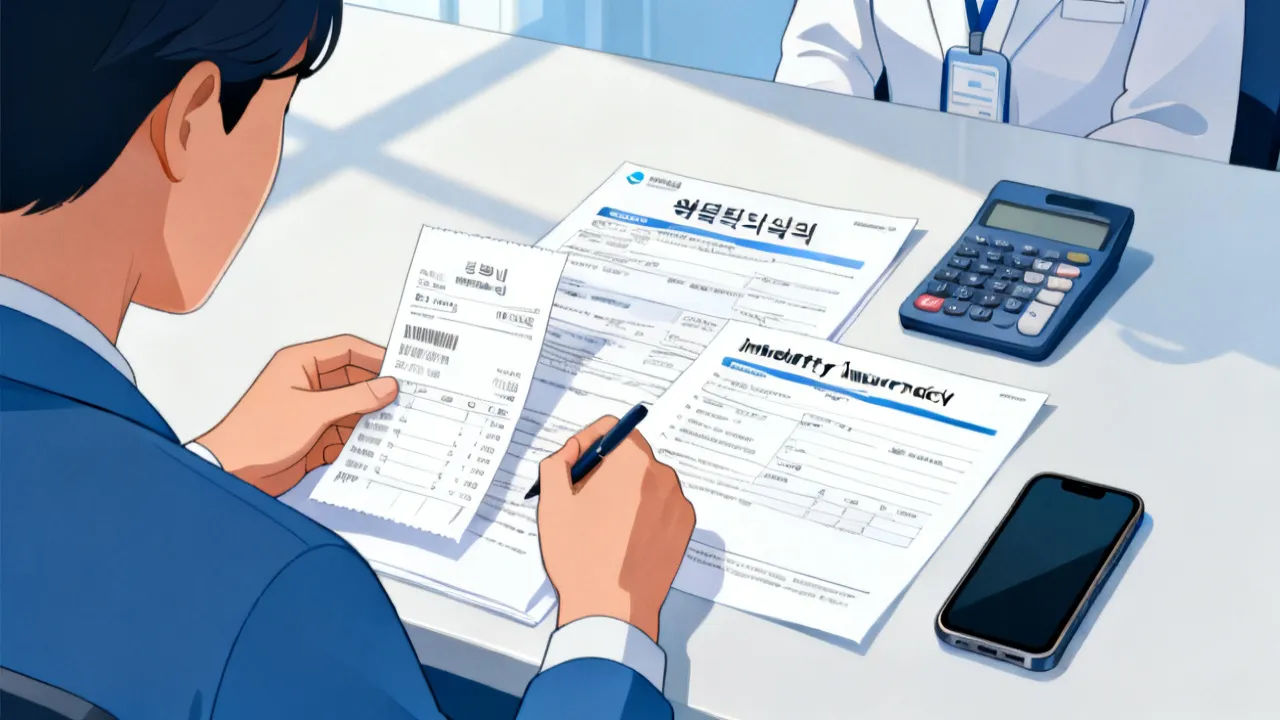
A receipt proves that a payment was made, but it may not identify the precise service. A detailed statement can show whether the charge was covered or non-covered, identify materials and procedures, and indicate separate amounts. A diagnosis document can establish the medical context. These documents serve different purposes, so one should not assume that any single document replaces the rest.
Before leaving the medical institution, check the patient name, treatment date, provider name, service description, amount, and classification. An administrative mistake can delay review. If the claim involves a non-covered item, ask the institution whether a document explains the treatment name and medical purpose. The provider may have its own document issuance procedure and fees for certain certificates.
It is sensible to ask the insurer what documents are required before paying for a relatively expensive certificate. Some claims can be processed with a receipt and detailed statement, while others require additional medical evidence. The policyholder can ask whether a particular document is mandatory, conditionally requested, or merely one possible form of evidence. This can reduce unnecessary expense while preserving the information needed for a fair review.
Step-by-Step Guide to Reviewing a 비급여 실비 Claim
Step 1: Identify the exact service
Begin with the detailed billing statement, not the total payment. Write down the name of each non-covered item, the date, quantity, unit price, and related diagnosis or department. If the description is abbreviated, ask the hospital or clinic to explain it in ordinary language.
Step 2: Confirm the applicable policy
Locate the policy schedule and the terms in force on the treatment date. Check whether the benefit is included, whether a special rider is required, and whether the policy distinguishes non-covered inpatient, outpatient, prescription, examination, or treatment expenses.
Step 3: Review exclusions and limitations
Read the exclusion section and any benefit-specific conditions. Pay attention to cosmetic care, preventive examinations, accommodation, health supplements, normal pregnancy-related expenses where applicable, unapproved services, investigational care, and expenses unrelated to the insured condition. Do not infer an exclusion from a general internet post; examine the actual contract.
Step 4: Calculate the possible deductible
Determine whether the policy uses a fixed amount, a percentage, a category-specific amount, or another method. Consider whether multiple visits are treated separately and whether an annual or per-incident limit affects the calculation.
Step 5: Match the medical evidence
Compare the invoice, diagnosis, prescription, treatment record, and procedure documentation. The service described on the bill should be consistent with the medical record. If the insurer requires an explanation of necessity, ask the provider for an objective document.
Step 6: Submit through an appropriate channel
Insurers may provide mobile applications, websites, email-based systems, postal submission, or branch service. Select the channel that can accept the required documents and retain confirmation of submission. For an electronic claim, save the receipt or application number.
Step 7: Review the result
When the insurer issues a payment or reduction notice, compare the decision with the submitted items. Separate eligible expenses, deductible amounts, excluded items, and missing evidence. If the explanation is unclear, ask for the contract provision and calculation details.
Step 8: Request reconsideration when appropriate
If a document was missing, a service was classified incorrectly, or the medical record was misunderstood, submit a focused request for reconsideration. Include the disputed item, the reason for disagreement, supporting documents, and the result you are asking the insurer to review. A concise, evidence-based request is usually more effective than a general complaint.
Comparison Table: Factors That Influence Reimbursement
| Review Factor | Questions to Ask | Practical Evidence |
|---|---|---|
| Policy date | Which contract was active on the treatment date? | Policy schedule, terms, renewal record |
| Service classification | Is the item covered, non-covered, excluded, or separately limited? | Detailed billing statement and policy wording |
| Medical purpose | Was the service connected to a documented illness, injury, or symptom? | Diagnosis, physician record, examination result |
| Deductible | What amount remains the policyholder’s responsibility? | Benefit schedule and insurer calculation |
| Frequency and limit | Has a yearly, visit-based, or category-based limit been reached? | Prior claim history and benefit statement |
| Document consistency | Do the date, service, diagnosis, and amount match? | Receipt, detailed statement, prescription, medical record |
| Submission status | Was the claim received and are additional documents requested? | Application number, message, or submission confirmation |
| Other payer | Has another policy, employer, or public program already paid part of the expense? | Payment statement, reimbursement record, related policy information |
Outpatient, Inpatient, and Pharmacy Claims
The setting of treatment can influence the documents and benefit calculation. Outpatient visits often involve a consultation, examination, procedure, medicine, and patient-paid amount on one date. Inpatient treatment may include room charges, nursing-related items, procedures, materials, medication, and multiple dates. Pharmacy claims may require a prescription and a separate payment receipt.
For outpatient care, the policyholder should check whether the deductible applies per visit or under another rule. A series of visits may not be combined in the same way under every policy. For inpatient care, review the admission and discharge dates, room type, operation record, and detailed billing statement. A room upgrade or personal convenience charge may be treated differently from a medically necessary hospital service.
For pharmacy expenses, the medicine must generally be connected to an eligible medical event and submitted with the required prescription and receipt. The presence of a prescription does not by itself establish that every product or charge is covered. Items such as supplements, personal-care products, or non-prescription purchases may be treated differently under the contract.
When the treatment continues over several dates, keep the documents in chronological order. This helps distinguish separate visits, recurring therapy, medication refills, and follow-up examinations. It can also help the insurer determine whether a frequency limit or annual category limit has been reached.
Special Issues Involving Examinations
Examination claims often generate questions because the same type of test may be used for different purposes. A test ordered to investigate a symptom, monitor a diagnosed illness, or evaluate a treatment response may have a different insurance analysis from a test requested solely as a personal health screening.
When submitting a claim for a non-covered examination, assemble the order, examination result, diagnosis information, and detailed charge. The record should make the clinical context understandable. If the policyholder received a test at the request of an institution, employer, school, or travel authority, the expense may require especially careful review because the main purpose may not be treatment of an insured medical condition.
The consumer should also distinguish between the examination itself and related charges. A consultation, interpretation fee, material charge, or administrative item may appear separately. Each line should be checked against the benefit terms rather than grouped automatically under one label.
If a test was ordered because of a symptom but the invoice describes it only as “screening,” ask the medical institution whether the billing description accurately reflects the service and purpose. Do not ask the provider to make a false change, but do request clarification when the ordinary billing label does not explain the clinical context.
Special Issues Involving Injections and Therapies
Injections and therapy sessions can be difficult to assess because the product, dosage, diagnosis, route, frequency, and purpose all matter. A non-covered injection may be associated with treatment of a documented condition, but the insurer may still ask whether the product and use fall within the policy’s coverage. Repeated therapy can also lead to questions about treatment frequency, progress, and the need for continued care.
Useful documents may include the prescription, treatment plan, procedure record, diagnosis, progress note, and detailed billing statement. The objective is not to obtain a document that promises reimbursement. It is to provide an accurate record of what happened and why the medical provider selected the service.
Policyholders should not ask a medical institution to change a diagnosis or service description merely to improve a claim. Insurance claims depend on accurate records. An inaccurate document can create additional legal and contractual risk and may undermine a legitimate claim.
For repeated therapy, a short treatment summary may be useful. It can identify the initial condition, the dates of treatment, the type of therapy, and the provider’s assessment of continued care. Whether such a summary is required depends on the insurer and the policy, but organized records can make the claim easier to review.
Why a Claim May Be Reduced or Declined
A reduced or declined claim does not necessarily mean that the medical service was improper. It may reflect the boundary of the insurance contract. Common reasons include:
- The expense is specifically excluded.
- The policy does not include the relevant non-covered benefit.
- The treatment was considered outside the contractual definition of illness or injury.
- The submitted records do not establish the medical purpose.
- The deductible exceeds or substantially reduces the eligible amount.
- A benefit limit or frequency limit has been reached.
- The claim was submitted under the wrong policy or for the wrong insured person.
- The receipt and detailed statement contain inconsistent dates or amounts.
- The service was classified as cosmetic, preventive, convenience-related, or investigational under the applicable terms.
- Additional evidence requested by the insurer was not submitted.
- The same expense was already reimbursed or submitted under another claim.
- The policy was inactive, terminated, or not yet effective on the treatment date.
When a claim is declined, request a written explanation that identifies the relevant policy provision and the specific evidence considered insufficient. An explanation such as “not covered” may be too general to support a meaningful review. Ask whether the issue concerns classification, medical necessity, documentation, a deductible, a limit, or an exclusion.
Do not assume that a decline is final merely because the first customer-service representative gives a brief answer. The representative may be describing a preliminary document review rather than a final contractual decision. Ask whether additional documents can be submitted and whether the claim can be reconsidered by the insurer’s claims department. At the same time, avoid repeatedly submitting identical documents without addressing the reason given for the decision.
How to Communicate With the Insurer
Clear communication improves the chance of resolving a factual misunderstanding. Use a simple structure:
- State the policy number or claim number.
- Identify the treatment date and medical institution.
- Name the disputed non-covered item and amount.
- Describe the insurer’s stated reason.
- Explain which document or fact you believe requires reconsideration.
- Attach the relevant evidence in chronological order.
- Ask for a written response and calculation breakdown.
Avoid making broad statements such as “all hospital charges should be paid” or “the doctor recommended it, so it must be covered.” More useful language is specific: “Please confirm whether the disputed injection was excluded because of the product classification, the diagnosis, the policy rider, or insufficient medical documentation.” This type of question helps identify the actual issue.
When speaking by telephone, write down the date, time, department, representative’s name or identification number if provided, and the substance of the explanation. If the matter is important, follow up through an official electronic or written channel so that the question and response are recorded. A clear record can be useful if different representatives later provide inconsistent explanations.
Official and Reliable Reference Points
Because insurance rules and administrative guidance can change, readers should use authoritative sources when confirming a disputed matter. Relevant reference points include:
- The Financial Supervisory Service: Consumer guidance and dispute-related information concerning insurance practices.
- The Korea Insurance Development Institute: Industry information and insurance-related reference materials.
- The National Health Insurance Service: Information about the public health-insurance system and patient payment structures.
- The Health Insurance Review and Assessment Service: Information related to medical treatment review and benefit classification.
- The insurer’s policy documents: The primary source for the individual contract, exclusions, benefit limits, and claim requirements.
- The medical institution: The source for accurate receipts, detailed statements, prescriptions, treatment records, and procedure documentation.
These sources serve different purposes. A public institution may explain the National Health Insurance framework, while only the private insurer can apply the wording of a particular contract to a claim. A medical institution can explain what it performed, but it cannot decide whether a private insurer must reimburse the charge. Keeping these roles separate prevents many misunderstandings.
Online communities can be useful for learning the vocabulary of a problem, but they are not reliable substitutes for official confirmation. A post may omit the policy date, rider, diagnosis, deductible, or claim history that determined the result. Treat examples as general illustrations rather than promises of the outcome of another person’s claim.
Consumer Protection and Dispute Review
If the policyholder believes a claim was handled incorrectly, the first step is normally to request an explanation and reconsideration from the insurer. Keep copies of the claim form, submitted documents, messages, letters, call records, and payment statement. Record the date and subject of each communication without altering the substance of what was said.
When the disagreement continues, consumers may consider the complaint or dispute-resolution channels available through relevant Korean financial authorities. The appropriate route depends on the issue, the insurer’s response, and the current administrative process. A consumer organization, licensed professional, or legal adviser may be useful for a complex dispute, particularly where the amount is substantial or the contract language is difficult.
Dispute procedures should not be used to submit inaccurate records or pressure a medical provider to create a preferred diagnosis. The strongest case is based on the original medical facts, the actual contract, and a clear explanation of why the insurer’s classification may be incorrect.
A dispute review is more persuasive when it identifies a concrete issue. Examples include a failure to consider a submitted medical record, an incorrect calculation of the deductible, use of the wrong policy terms, confusion between two invoice items, or an explanation that conflicts with the written contract. A general assertion that the result is unfair may be understandable, but a specific factual or contractual error is easier to investigate.
Privacy and Data Security During Claims
Medical claims contain sensitive personal information. Submit documents through an insurer’s verified application, website, branch, or designated channel. Before sending files, confirm the recipient and remove unrelated medical information when the insurer does not require it, while preserving the documents needed for the claim.
Do not post medical records, resident registration information, policy numbers, or claim screenshots in public online communities. When using an agency or representative, confirm the person’s authority and understand what information will be shared. Store submission confirmations securely and retain the original documents according to the policyholder’s own record-keeping needs.
When photographing documents for mobile submission, check that all corners, names, dates, amounts, and page numbers are visible. Avoid blurry images, strong shadows, or cropped pages. If a document contains multiple pages, upload them in order. Good image quality does not guarantee payment, but poor image quality can create an avoidable request for resubmission.
Practical Record-Keeping System
A simple record system can make 비급여 실비 claims easier to review. Create one folder for each treatment episode and use a consistent file name such as “treatment date–institution–document type.” Keep the following sequence:
- Appointment or admission information
- Diagnosis and treatment notes
- Prescription or procedure record
- Receipt
- Detailed billing statement
- Claim submission confirmation
- Insurer questions and responses
- Final payment or decline notice
When several family members have policies, label the insured person clearly. Confusing the policyholder, insured person, and claimant can cause avoidable delays. If a treatment involves several visits, maintain a chronological list of dates and amounts. This is particularly helpful when the insurer asks about recurring services or when a policy applies a visit-based deductible.
Keep a separate note of the amount actually paid by the patient and the amount later reimbursed. The two amounts may differ for legitimate reasons, and recording both makes it easier to identify the deductible, excluded items, and remaining balance. If another insurance policy contributes to the payment, record that information as well so that the claim can be reported accurately.
Common Mistakes to Avoid
- Submitting only a card receipt: A payment record may not show the treatment category or medical purpose.
- Assuming every non-covered charge is eligible: Coverage depends on the contract and facts.
- Using an old policy explanation: Product terms and administrative guidance may differ by contract period.
- Ignoring the deductible: The amount paid by the policyholder can be significant even when the service is eligible.
- Waiting until documents are difficult to obtain: Request records while the treatment details are still easy to verify.
- Combining unrelated treatment episodes: Separate claims can make the facts clearer.
- Relying on informal online examples: Another person’s result may involve a different policy and diagnosis.
- Asking for altered documents: Claims should reflect accurate medical and financial information.
- Failing to read a decline notice: The notice may identify a specific document or contract clause that can be addressed.
- Assuming a high payment means high reimbursement: Expensive treatment can still be limited or excluded.
- Ignoring prior claims: Annual or frequency limits may depend on previous payments.
- Canceling or replacing a policy without review: A change can affect future protection and may not resolve a disputed claim.
Frequently Asked Questions
Is every 비급여 expense reimbursed through 실비 insurance?
No. 비급여 identifies a public health-insurance classification, while 실비 reimbursement depends on a separate private insurance contract. The insurer may apply exclusions, deductibles, limits, and medical-documentation requirements. Check the policy and the specific item on the detailed billing statement.
Does a doctor’s recommendation guarantee payment?
No. A doctor’s recommendation can support the medical purpose of a service, but it does not override policy exclusions or benefit limits. The insurer may also need treatment records, a diagnosis, a prescription, or an examination result.
Can a non-covered examination be claimed?
It may be claimable under some contracts and circumstances, but the result depends on the policy period, benefit structure, purpose of the examination, diagnosis, deductible, and supporting evidence. An examination for a documented symptom may be assessed differently from personal screening.
What is the most important document?
There is no single document that is always sufficient. The receipt proves payment, the detailed statement explains the charge, and medical records establish the clinical context. A complete claim often requires several documents that are consistent with one another.
Why was only part of my hospital bill reimbursed?
The bill may contain several categories of expense. Some may be eligible, some may be subject to a deductible or limit, and others may be excluded. Ask the insurer for an itemized calculation showing the treatment classification and reason for each adjustment.
Does the policy generation affect non-covered claims?
Yes, it can. Products issued in different periods may have different deductibles, riders, limits, exclusions, and benefit structures. Confirm the contract that was active on the treatment date instead of relying on a general generation label.
Can I submit a claim through a mobile application?
Many insurers provide electronic claim channels, but available functions and document requirements differ. Use the insurer’s authenticated application or official submission route, retain the claim number, and confirm whether additional originals or certificates are required.
What should I do if the insurer asks for more documents?
Read the request carefully and identify the exact item needed. Ask the medical institution for an accurate document that addresses the request. If the request is unclear, ask the insurer whether it concerns medical necessity, service classification, identity, payment, or policy eligibility.
Can I claim a charge that was paid by another person?
The answer depends on the contract and evidence of payment. The insured person, policyholder, and payer may be different in some situations, but the insurer may request additional proof or authorization. Confirm the requirement before submission.
What if the hospital uses an unfamiliar name for the service?
Request a detailed statement and an explanation from the medical institution. The insurer needs an accurate description of what was actually performed. Do not replace the provider’s terminology with an assumed label.
Can repeated therapy be claimed indefinitely?
No assumption of indefinite reimbursement is appropriate. Repeated treatment may be subject to policy limits, review of medical necessity, frequency conditions, or exclusions. Keep a treatment plan and progress records where available.
Should I cancel a policy after a claim is declined?
A declined claim alone is not a sufficient basis for a major financial decision. First determine why the claim was declined, whether the explanation is contractually supported, and how cancellation or conversion would affect future protection. Consider objective advice before changing coverage.
Is a non-covered charge always more difficult to claim than a covered charge?
Not necessarily, but non-covered expenses often require more careful classification and documentation. A covered patient portion may be processed under a relatively clear benefit, while a non-covered item may involve a separate rider, category limit, or medical-purpose review. The difficulty depends on the policy and the facts.
Can the insurer ask for medical records even if the claim amount is small?
It can request evidence that is reasonably relevant to determining eligibility, although actual requirements may vary by insurer and claim. A small claim may be processed with basic documents, while unusual, repeated, or ambiguous expenses may result in additional questions.
Expert Perspective: A Better Way to Think About 비급여 실비
From an insurance-analysis perspective, the most reliable approach is to treat a claim as a chain of evidence rather than as a single bill. The chain begins with the policy, continues through the diagnosis and treatment decision, and ends with the financial record. A weakness at any point can affect the assessment, even when the treatment itself was genuine and medically appropriate.
Consumers often focus on the word 비급여 because it appears prominently on a hospital statement. The more important analytical questions are whether the private contract includes that category, whether the service was connected to an insured condition, whether the amount falls within a limit, and whether the records explain the event. This approach is more precise than relying on broad statements about what “usually” happens.
It is also important to distinguish eligibility from payment amount. A service may qualify in principle but produce a limited payment after deductibles and sublimits. Conversely, a high-value service may not qualify if the policy excludes it. Reviewing these questions in order reduces confusion:
- Is there an applicable benefit?
- Is the treatment within the benefit’s definition?
- Does an exclusion apply?
- Is the medical purpose documented?
- What deductible and limit apply?
- Are the documents complete and consistent?
This six-part review is suitable for routine consumer checking, although it cannot replace an insurer’s formal assessment or professional advice in a complex dispute.
A useful additional distinction is between factual uncertainty and contractual uncertainty. Factual uncertainty concerns what actually happened: which treatment was given, when it occurred, how much it cost, and why the provider selected it. Contractual uncertainty concerns whether the policy covers that event. Factual problems are often addressed through receipts, medical records, and provider explanations. Contractual problems require careful reading of the policy terms and the insurer’s reasoning. Identifying which type of uncertainty exists can make the next step much clearer.
Final Checklist Before Submission
- Confirm the insured person and policy number.
- Check the treatment date against the contract period.
- Separate covered, non-covered, and miscellaneous charges.
- Obtain a receipt and detailed billing statement.
- Confirm the diagnosis or medical purpose.
- Collect prescriptions, procedure records, or examination results when relevant.
- Review deductibles, limits, exclusions, and special riders.
- Check that names, dates, service descriptions, and amounts match.
- Confirm whether another insurer or payer has reimbursed part of the expense.
- Submit through a verified insurer channel.
- Keep the submission confirmation and all communications.
- Review the insurer’s payment calculation or explanation.
- Request reconsideration with focused evidence if a factual or classification error appears.
Conclusion
비급여 실비 is best understood as a policy-specific reimbursement question, not as an automatic payment category. Non-covered medical expenses can involve examinations, medicines, materials, injections, therapy, procedures, and convenience-related charges, each of which may receive a different insurance treatment. The decisive factors are the contract in force, the medical purpose, the service classification, exclusions, deductibles, limits, and quality of supporting records.
A careful claimant begins with the detailed bill, verifies the applicable policy, gathers consistent medical evidence, and asks the insurer for a transparent calculation. When uncertainty remains, consult the insurer and relevant official institutions rather than relying on unverified examples. Accurate records and a structured review provide the strongest foundation for understanding a 비급여 실비 claim and making informed decisions about the next step.
The most practical habit is to avoid treating the hospital bill, the National Health Insurance classification, and the private insurance decision as though they were the same thing. They are related, but they answer different questions. The hospital bill records the services and charges. The public system determines which services fall within its benefit framework. The private insurer applies an individual contract to the patient’s eligible expense. Reviewing these layers separately helps consumers ask better questions, submit better evidence, and understand the result even when reimbursement is partial or unavailable.